


Sizing and Selecting Reliable Hot Water for Every Household
Waking up to an unexpected blast of freezing water in the middle of a morning shower quickly reveals the limits of an aging or undersized utility setup. Household demand fluctuates wildly throughout the day, especially when laundry machines, dishwashers, and multiple bathrooms draw from the supply at the exact same moment. Selecting the best water heater for home setups involves balancing practical hot-water volume against household utility panels and available installation space. Whether your setup requires a multi-breaker whole-house tankless unit or a dedicated point-of-use tank under a kitchen sink, matching heater capacity to daily routine keeps hot water flowing without sudden drops.
Small utility closets, tight crawl spaces, and compact apartments often demand slim wall-mounted units rather than bulky 50-gallon tanks that dominate floor space. Modern systems range from high-draw 240-volt on-demand heaters like Rheem and Westinghouse to versatile 120-volt plug-in storage tanks from GE and VEVOR. When outfitting small utility rooms, secondary cabins, or workshops where you might also add a compact indoor heater during colder months, paying close attention to your main panel amperage and dedicated breaker ratings prevents unexpected electrical trips. Evaluating listed flow rates, recovery times, and physical dimensions before buying ensures you get reliable warmth tailored to your plumbing layout.

Pros
- Space-saving footprint mounts easily directly below kitchen, bar, or powder-room sinks
- On-demand heating design eliminates the standby energy loss of traditional tank heaters
- Digital interface provides immediate visual confirmation of active water temperature
- Built-in protection suite guards against dry firing, overheating, and electrical leakage
Cons
- Strictly unsuitable for showers or whole-home use due to low flow capacity between 0.3 and 0.5 GPM
- High electrical draw requires a dedicated circuit breaker over 32 amps on a standard 110V line
- Requires strict vertical orientation to prevent element damage and system error codes
The xwdzswgs 110V 3000W electric tankless water heater is designed specifically as a point-of-use supplemental heating unit for low-demand fixtures. Rather than replacing a central domestic water heater, this compact wall-mounted unit serves individual sinks in powder rooms, kitchen prep areas, wet bars, workshops, and recreational vehicles. For homeowners or renters seeking faster warm water without running extensive plumbing lines from a distant utility room, this on-demand device delivers a functional, localized solution.
Heating performance centers around a 3000W heating core powered by a 110V supply. According to manufacturer specifications, the unit can raise water temperatures to between 82 degrees Fahrenheit at a 0.3 gallon-per-minute flow rate and up to 131 degrees Fahrenheit at 0.5 gallons per minute. An integrated digital screen clearly displays real-time temperature readings, and users can toggle between Fahrenheit and Celsius by pressing and holding the power button for six seconds. Because temperature output is directly tied to incoming flow rate and groundwater temperature, keeping water flow modest is essential for achieving warm temperatures.
The build combines ABS plastic housing with stainless steel internal components, resulting in a lightweight footprint measuring 4.32 x 4.32 x 7.86 inches. The appliance incorporates several active safety mechanisms, including physical water-and-electricity isolation, dry-boil cutoff, overheating protection, and automatic shutoff during extended inactivity. It carries an IPX4 water-resistance rating to withstand occasional splashes inside damp vanity cabinets, and the manufacturer notes design adherence to ETL standards alongside a 98 percent thermal efficiency rating.
Proper setup requires close attention to plumbing and electrical specifications. The unit uses standard 1/2-inch NPT pipe fittings and pre-drilled screw points for straightforward wall attachment. However, the manufacturer mandates vertical-only installation; mounting the unit horizontally or failing to seal pipe joints with Teflon tape can cause water pooling, element burnout, or system error codes. Electrically, drawing 3000W at 110V demands substantial current. The manufacturer specifies wiring with a cross-sectional area of at least 2.5 square millimeters connected to a dedicated breaker rated above 32 amps.
Understanding real-world limitations is critical before choosing this unit. This heater is explicitly not suitable for showers, which typically require a minimum flow rate of 1.8 gallons per minute, nor can it supply simultaneous fixtures. In colder northern climates where incoming winter tap water drops significantly, the small heating element may struggle to reach handwashing temperatures unless the faucet is adjusted to a very slow trickle.
For buyers needing a compact, budget-conscious way to warm water at an isolated sink, this mini tankless heater offers practical utility. It functions reliably for quick handwashing and rinsing when paired with an adequately rated 32-amp circuit and installed strictly according to vertical mounting guidelines.
Operating a 3000W heating element on a standard 110V line generates a high continuous electrical load. To maintain safety and prevent nuisance breaker tripping, the manufacturer explicitly requires wiring with a conductor cross-section of at least 2.5 square millimeters and connection to a dedicated circuit breaker rated over 32 amps.
This device should never be plugged into a general-use convenience outlet, power strip, or shared household circuit. Prospective buyers must confirm their electrical panel has sufficient spare amperage capacity and proper wire gauge before purchasing.
Physical mounting must follow strict orientation rules. The manufacturer specifies vertical installation only; mounting the heater on its side or upside down can cause air pockets around the heating element, leading to dry firing, operational failure, and E2 error codes.
Plumbing connections utilize standard 1/2-inch NPT threads. Installers should apply Teflon tape generously to all pipe joints to eliminate leaks near electrical components, ensuring safe operation within under-sink cabinets or utility spaces.
The appliance incorporates multi-stage protection designed to safeguard residential installations. Key safeguards include physical separation between the electrical heating components and the water pathway, automatic leakage protection, and a dry-boil cutoff that disables power if no water is present.
Overheat protection and inactivity shutoffs ensure the unit powers down when safe thermal limits are reached or when water stops flowing. Additionally, an IPX4 ingress rating protects internal electronics from splash damage in wet sink environments.
Pros
- Delivers continuous on-demand hot water up to 5.9 GPM across multiple fixtures
- Ultra-compact 3.5-inch profile saves floor space in tight utility rooms or closets
- Precise digital thermostat adjusts in 1-degree increments between 80°F and 140°F
- Zero venting requirements make placement simpler than gas tankless models
Cons
- Demanding electrical setup requires three 40-amp double-pole breakers and a 200-amp main panel
- Does not include installation wiring or breakers in the box, requiring separate purchase and professional setup
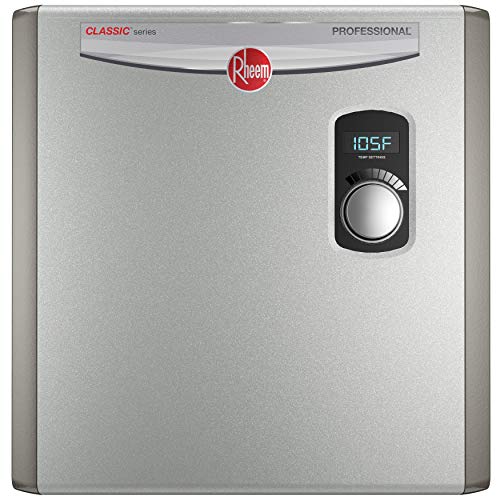
The Rheem RTEX-24 is a 24kW, 240-volt electric tankless water heater engineered to provide continuous, on-demand hot water for multiple fixtures. Designed for residential homeowners and remodelers, this unit replaces bulky storage tanks with a wall-mounted profile that fits into utility closets, basements, or laundry areas. It suits households that want an energy-conscious hot water supply without allocating significant floor area to a traditional storage cylinder.
In terms of water heating performance, the RTEX-24 is rated for up to 5.9 gallons per minute (GPM) depending on incoming groundwater temperatures. Water heats instantly as it flows through the heating elements, eliminating standby energy consumption common in standard storage tanks. The front interface features digital thermostatic controls that let you adjust outgoing water temperature in 1-degree increments from 80°F to 140°F (26°C to 60°C), providing predictable and steady hot water delivery.
The unit features a slim gray housing that measures 18.25 inches high, 14.5 inches wide, and only 3.5 inches deep. Weighing in at 17.8 pounds, the lightweight and compact chassis is roughly 90 percent smaller than standard tank water heaters. This slim form factor allows for clean wall mounting in tight mechanical spaces where floor room is at a premium.
Installation planning requires strict attention to your home's electrical capacity. The RTEX-24 operates on 240V single-phase power and demands three dedicated 40-amp double-pole circuit breakers, along with three individual sets of #8 AWG copper conductors with ground. Rheem recommends a minimum 200-amp household electrical service panel to handle this load safely. Because it is completely electric, no venting, flues, or gas lines are required, avoiding the exterior penetrations needed for gas tankless models.
Before choosing this model, buyers must verify their electrical panel capacity and local incoming water temperatures. Homes with 100-amp or 150-amp main electrical services will require a panel upgrade before installing this 24kW system. Additionally, actual flow rate at a comfortable shower temperature varies based on northern versus southern incoming groundwater temperatures, meaning high-demand multi-bath homes in colder regions should verify whether 24kW meets peak winter needs.
For homeowners and remodelers with adequate electrical service who want to eliminate bulky tank storage, the Rheem RTEX-24 offers a practical, space-saving hot water solution. Backed by a 5-year leak warranty and a 1-year parts warranty, it delivers reliable digital temperature management and zero venting hassles when properly sized and professionally wired.
The Rheem RTEX-24 requires 240-volt single-phase power and draws significant electrical current under full demand.
Proper operation requires three separate 40-amp double-pole circuit breakers inside your breaker panel.
Wiring must consist of three independent sets of #8 AWG copper conductors with ground.
The manufacturer recommends a minimum 200-amp residential electrical service panel to support the unit alongside other major household appliances.
Rheem provides a 5-year limited warranty protecting against tank or heating chamber leaks under normal residential use.
Functional components and internal electrical parts are covered by a 1-year limited parts warranty.
Professional installation by a licensed electrician or plumber is recommended to ensure compliance with local electrical and plumbing codes and to maintain warranty coverage.

Pros
- Delivers on-demand hot water with a maximum rated flow of 3.38 GPM without the bulky footprint of a storage tank
- Digital interface allows precise water temperature adjustments between 86°F and 140°F
- ETL certified with comprehensive safety features including leakage, dry-fire, and over-temperature protection
- Ultra-compact profile fits easily in tight laundry closets, under cabinets, or in utility corners
Cons
- Demands significant electrical infrastructure including a 150-amp household service panel, a 60-amp double-pole breaker, and 6 AWG wiring
- Maximum 3.38 GPM output may limit simultaneous high-volume fixtures in regions with very cold incoming groundwater
- Requires hardwired electrical and dedicated plumbing installation rather than plug-in operation
The Orbek 14kW electric tankless water heater is designed for households seeking continuous, on-demand hot water without sacrificing valuable square footage to a conventional storage tank. Operating on a 240-volt electrical supply, this point-of-use unit is rated to deliver up to 3.38 GPM, making it well-suited for small homes, apartments, cabins, or supplemental point-of-use installations supporting two to three simultaneous fixtures like a kitchen sink and a bathroom shower.
In terms of heating performance, the unit produces warm water within roughly three seconds of flow detection. Temperature management is handled via an integrated microchip that adjusts power delivery up to 20,000 times per second, engineered to keep water output steady within 1°F of the set target. Users can dial in their desired temperature between 86°F and 140°F using the clear, backlit LED display, which continuously shows real-time water temperature to eliminate guesswork during everyday use.
Build quality centers on safe residential operation and long-term durability. The heater is ETL certified and incorporates water-and-electricity separation technology, which isolates electrical components from direct fluid contact to reduce corrosion and mineral scaling. The internal protection suite includes automated dry-heating shutoff, over-temperature limiting, leakage detection, and built-in lightning resistance, ensuring that the appliance halts operation if irregular electrical or thermal conditions arise.
Installation and physical setup require careful planning around your home electrical capacity. The chassis measures a compact 14.2 inches high, 9.5 inches long, and 3.1 inches wide, mounting flat against a wall to conserve space in closets or under sink bases. Plumbing lines connect via standard 1/2-inch NPT fittings. Electrically, the manufacturer specifies that the home main breaker panel must provide at least 150 amps of total service capacity, requiring a dedicated 240V/60A two-pole breaker and 6 AWG copper wiring for compliant, safe hardwired setup.
Prospective buyers must consider incoming groundwater temperatures when evaluating the 3.38 GPM maximum flow rate. While this flow rate is sufficient for simultaneous moderate uses in warmer climates, colder northern inlet water requires the unit to work harder to achieve a comfortable shower temperature, which naturally reduces usable flow rate. Additionally, homes with older 100-amp electrical panels will need an electrical service upgrade before this 14kW heater can be operated safely.
Overall, the Orbek 14kW tankless water heater is a practical and efficient option for homeowners and renters who have verified their electrical panel capacity. Its compact size, rapid response time, ETL certification, and steady digital temperature controls make it a dependable upgrade for targeted multi-point or compact whole-home water heating.
Safe operation of the Orbek 14kW tankless water heater requires dedicated high-amperage electrical infrastructure. The manufacturer states that the main electrical panel must have a minimum total capacity of 150 amps to handle the operational draw alongside other household appliances.
The unit requires a hardwired connection to a dedicated 240-volt, 60-amp two-pole circuit breaker using one set of 6 AWG copper wires. Because of these specific electrical demands, installation by a licensed electrician is strongly recommended to ensure proper breaker sizing, grounding, and adherence to local building codes.
The Orbek water heater features an intuitive digital interface with a high-definition, backlit LED display that provides clear visibility even in dim utility spaces. Users can fine-tune hot water output across an adjustable temperature range of 86°F to 140°F.
An onboard microprocessor actively monitors incoming conditions and modulates heating power up to 20,000 times per second. This rapid adjustment helps prevent sudden cold bursts or scalding spikes, keeping the delivered water temperature stable within a tight 1°F margin during uninterrupted flow.

Pros
- Compact wall-mount profile saves floor space in utility closets, cabins, and small homes.
- Fast 3-second heating with up to 3.4 GPM capacity to supply up to two fixtures at once under moderate inlet temperatures.
- Convenient smart management via Wi-Fi, smartphone app, and voice integration with Alexa or Google Home.
- Multi-layer safety design featuring ETL certification, IPX4 splash resistance, and isolated electrical-water pathways.
- Tool-free removable filter and rotor make routine six-month descaling and maintenance straightforward.
Cons
- Requires a dedicated 240V 60A double-pole breaker and 6 AWG wire, which may necessitate an electrical panel upgrade.
- Flow rate depends on incoming groundwater temperature, which can limit simultaneous fixture use in cold winter climates.
- Requires a minimum startup flow rate of 0.53 GPM before heating elements activate.
The Westinghouse 14kW Electric Tankless Water Heater is an on-demand, tankless water heating unit engineered for residential spaces, apartments, cabins, and home remodel projects. Designed to replace bulky traditional tank heaters or serve as a dedicated point-of-use unit, this model targets homeowners, property managers, and remodelers seeking space-saving efficiency. It provides continuous hot water on demand without storing gallons of standing water, making it a functional upgrade where interior square footage is at a premium.
Heating performance centers on a rapid three-second response time and a manufacturer-rated 98 percent thermal efficiency. With an incoming water temperature of 62 degrees Fahrenheit and a target output of 105 degrees Fahrenheit, the unit supplies up to 3.4 gallons per minute (GPM), which is sufficient to handle up to two water fixtures simultaneously under those conditions. The heating cycle activates automatically at a minimum startup flow rate of 0.53 GPM, ensuring the system engages consistently during standard sink or shower use.
Internal build quality emphasizes long-term component isolation and multi-stage safety. The heating core utilizes a separated water-and-electricity pathway designed to limit internal corrosion and reduce scale accumulation on active components. For environmental and electrical security, the unit carries an ETL certification, an IPX4 water-resistance rating, and anti-fog technology that permits safe wall installation inside damp utility spaces or bathrooms. Integrated safeguards also include four-layer protection covering electrical leakage, overheating, dry-fire events, and over-voltage spikes.
Installation and layout planning require specific electrical and plumbing provisions. The exterior measures a compact 12.59 inches high by 9.56 inches wide by 3.28 inches deep and connects via standard 1/2-inch NPT plumbing fittings. On the electrical side, the system operates on 240 volts and mandates a dedicated 60-amp double-pole breaker wired with 6 AWG copper conductors. Day-to-day operation is streamlined through built-in Wi-Fi connectivity, allowing temperature adjustments and monitoring through a mobile app or voice commands via Amazon Alexa and Google Home, complemented by an internal memory feature that restores previous settings following power outages.
Operating limitations must be factored into any home layout, particularly regarding regional climate and existing panel capacity. Because tankless heating output is dictated by temperature rise, incoming water temperatures well below 62 degrees Fahrenheit in colder northern regions will reduce the available GPM, potentially restricting the unit to a single fixture at a time. Prospective buyers must also verify that their home electrical service can accommodate an additional 60-amp dedicated load without requiring an expensive panel upgrade.
For homeowners, cabin builders, or apartment remodelers with adequate 240-volt electrical service, the Westinghouse 14kW tankless unit offers a dependable, compact solution for on-demand hot water. Routine maintenance is straightforward thanks to a hand-removable inlet filter and rotor that can be rinsed every six months to sustain clear water flow. When matched with compatible incoming water temperatures and proper wiring, this unit provides modern smart controls and continuous hot water while reclaiming valuable interior space.
The Westinghouse 14kW tankless water heater requires a dedicated 240-volt electrical service connected to a 60-amp double-pole circuit breaker using 6 AWG wiring. It is essential to ensure your primary electrical panel has sufficient spare amperage capacity before planning installation.
Plumbing connections utilize standard 1/2-inch NPT fittings for incoming cold water and outgoing hot water lines. The unit initiates heating at a minimum activation flow rate of 0.53 GPM and measures 12.59 inches high by 9.56 inches wide by 3.28 inches deep, mounting directly to interior wall surfaces to eliminate floor footprint.
Integrated Wi-Fi connectivity enables remote temperature adjustments and operational monitoring through a smartphone application or voice prompts using Amazon Alexa and Google Home. An automated temperature memory function remembers and restores your previous setting following a household power outage.
Operational safety is verified by ETL certification and an IPX4 splash-proof rating with anti-fog moisture resistance suitable for bathroom utility placement. Internal hardware includes four-layer safety monitoring against overheating, dry-fire hazards, electrical leakage, and voltage surges alongside fully separated water and electrical pathways.
Routine maintenance centers on inspecting and cleaning the integrated cold water inlet filter and internal rotor, both of which can be detached by hand without specialized tools. The manufacturer recommends rinsing these components every six months to flush out trapped sediment and mineral scale.
Periodic rinsing helps preserve optimal flow dynamics and protects internal heat-transfer components from premature mineral accumulation. Keeping the inlet screen clear ensures consistent 0.53 GPM activation and maintains the unit's rated 98 percent thermal transfer efficiency over extended service.

Pros
- Includes a standalone digital LCD thermometer to check container water temperatures
- Equipped with a 304 stainless steel protective guard around the heating tube
- Comes with basic maintenance accessories including sandpaper and a stainless steel cleaning ball
- Delivers 2000W electric heating capacity for utility buckets and small water vessels
Cons
- Category mismatch: Not an automotive heater core and cannot be installed in vehicle cooling systems
- Incompatible power source: Requires a 110-125V AC wall outlet rather than automotive 12V DC power
- Lacks automotive specifications such as core dimensions, inlet/outlet tube sizes, and OEM interchange numbers
This product is a HUVOPUMO 2000W portable electric immersion water heater designed for heating water inside buckets, washbasins, small tubs, and camping containers. Vehicle owners, DIY repairers, and technicians researching automotive replacement heater cores should be aware of a distinct category mismatch. Retail catalog searches for heating components occasionally surface immersion elements, but this device is a plug-in household appliance rather than an automotive heat exchanger intended for a vehicle passenger compartment.
Based on the supplied product specifications, this immersion heater operates at 2000 watts using standard 110-125V AC electrical power. It features a perforated 304 stainless steel protective cover intended to prevent direct contact with the internal heating element. The package contains the immersion heater, a digital LCD thermometer, a stainless steel cleaning ball, sandpaper for surface scale removal, and two instruction manuals. The listing provides no automotive original equipment manufacturer part numbers, core dimensions, inlet or outlet tube configurations, or vehicle make and model compatibility, as it is not engineered for automotive HVAC assemblies.
In an automotive heating system, a true heater core serves as an air-to-liquid heat exchanger positioned inside the vehicle dashboard plenum. Engine coolant circulates through the core tubes, and the vehicle blower motor forces air through the exterior fins to supply warmth to the cabin and defog the windshield. Drivers observing symptoms such as faint cabin heat, sweet coolant odors, greasy windshield haze, or wet passenger carpeting frequently suspect a failing heater core. However, symptoms alone do not confirm heater core failure. Low coolant levels, trapped air pockets, stuck thermostats, or failed blend door actuators can produce similar conditions without requiring a replacement core.
For shoppers looking to resolve a vehicle heating problem, careful verification of exact vehicle specifications is essential before ordering any replacement component. Genuine automotive heater cores require precise matching by model year, make, model, engine displacement, and air conditioning configuration. Parts buyers must check tube angles, inlet and outlet diameters, core dimensions, and OEM reference numbers against reliable vehicle-specific catalogs. An immersion bucket heater cannot interface with automotive plumbing or vehicle cooling systems.
The HUVOPUMO immersion heater includes strict manufacturer warnings regarding container use, requiring complete liquid submersion before connecting power, avoidance of water contact during operation, and a maximum continuous use limit of three hours. For non-automotive utility tasks such as warming bucket water for washing or camping, the included thermometer and protective guard serve practical purposes. For automotive repair needs, this product should not be purchased as an automotive replacement part. Vehicle owners and technicians should conduct proper diagnostic checks and source an application-specific automotive heater core.
This product is an electric immersion bucket heater designed solely for heating water in containers, small tubs, and outdoor camping vessels. It is not an automotive heater core and cannot be plumbed into an engine cooling system or HVAC distribution box.
Vehicle owners searching for heating system replacement parts must reference vehicle-specific catalogs using the exact year, make, model, and engine configuration to locate appropriate heat exchangers.
Cabin heating symptoms such as insufficient heat from dashboard vents, coolant odor, or damp carpeting on the passenger side do not automatically confirm heater core failure. Restricted coolant flow, faulty thermostats, clogged heater hoses, or binding blend door actuators can produce identical symptoms.
Thorough cooling system inspection and diagnostic testing should always precede the purchase of replacement automotive components to ensure the correct issue is addressed.

Pros
- 18-gallon storage tank balances capacity with a manageable vertical footprint.
- User-friendly mechanical knob allows easy temperature adjustment from 86 to 167 degrees Fahrenheit.
- 20mm foam insulation layer helps reduce standby heat loss over extended periods.
- Corrosion-resistant enamel glass coating enhances interior tank durability.
Cons
- Empty weight of 53 pounds becomes significantly heavier when filled with 18 gallons of water, requiring sturdy floor or wall support.
- At 1600W, recovery time will be slower than high-output whole-home residential water heaters after continuous heavy use.
- Side connection orientation and dedicated electrical hookup may require plumbing adjustments depending on existing pipe layout.
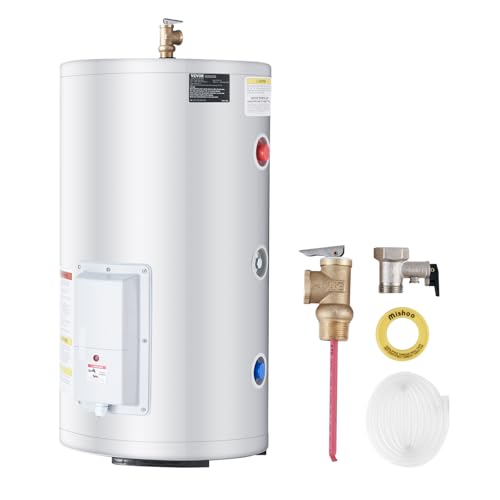
The VEVOR 18-Gallon Electric Water Heater is a dedicated storage-tank water heating appliance designed for homeowners, small businesses, cabins, and workshop spaces requiring reliable hot water without a massive central utility footprint. With its 18-gallon (70-liter) capacity, this unit provides a practical middle ground between tiny point-of-use under-sink heaters and bulky whole-house water cylinders. It serves households looking to supply a dedicated shower, laundry sink, detached guest suite, or remote commercial wash station with consistent heated water on demand.
Water heating performance relies on an internal 1600W immersion heating element capable of warming water up to 167 degrees Fahrenheit (75 degrees Celsius). Operational control is kept straightforward through an external rotary knob that lets users dial in target water temperatures between 86 degrees Fahrenheit and 167 degrees Fahrenheit (30 to 75 degrees Celsius). A built-in LED heating display provides immediate visual feedback on the heating status. Because this is a tank-style storage heater rather than a true high-amperage tankless unit, it stores preheated water for immediate flow at the faucet rather than demanding massive electrical service spikes.
The structural integrity of the water heater centers on an enamel glass-lined inner tank engineered to resist corrosion, scale buildup, and tank leakage over years of exposure to pressurized water. Surrounding the inner reservoir is a 20mm HFO foam insulation layer enclosed within a rigid high-pressure metal outer shell, designed to minimize standby heat loss and retain hot water for up to 24 hours. The unit also carries an IPX4 waterproof rating, offering defense against splashing water in damp environments such as basements, utility closets, or commercial wash areas.
Setup requires planning around the unit physical specifications and side plumbing connections. Measuring approximately 16.14 by 16.14 by 30.71 inches with an empty weight of 53 pounds, the heater requires a solid, level mounting surface or floor placement that can support the full weight once filled with roughly 150 pounds of water. Users must ensure appropriate clearance around the side water connections and follow local electrical codes for the 1600W load. Routine maintenance primarily involves periodic inspection of fittings, checking the tank integrity, and standard seasonal draining if installed in unconditioned outbuildings subject to freezing.
While the 18-gallon capacity handles single-fixture tasks such as a short shower, handwashing, or dish cleanup easily, it is not sized to run multiple high-demand fixtures simultaneously across an entire home. The 1600W immersion element emphasizes manageable electrical draw rather than rapid high-volume recovery, meaning consecutive long showers will deplete the hot water supply and require recovery time. Additionally, buyers must account for the side connection orientation when planning pipe routing in tight utility spaces.
For property owners seeking a dedicated, medium-capacity hot water source for a cabin, workshop, utility room, or small apartment bathroom, this VEVOR model offers an accessible balance of insulation, straightforward temperature control, and tank durability. As long as users match their hot water expectations to its 18-gallon storage volume and 1600W heating rate, it delivers dependable point-of-use utility without the complex electrical requirements of whole-house tankless systems.
This electric water heater stores 18 gallons (70 liters) of water heated by an internal 1600W immersion element. The stored volume is well suited for individual applications, such as a utility room sink, small bathroom shower, or kitchen station, reducing the wait time for hot water compared to drawing from a distant central boiler.
Because the unit uses a 1.6KW heating element, recovery time after exhausting the full 18 gallons will be gradual. Users planning for high-volume, back-to-back hot water demands should pace usage according to the tank capacity rather than expecting instantaneous continuous flow.
Temperature management is operated via a front-mounted mechanical rotary knob, allowing continuous adjustment from 86 degrees Fahrenheit to 167 degrees Fahrenheit (30 to 75 degrees Celsius). This manual control avoids complicated programming while allowing users to calibrate output for handwashing or high-temperature cleaning.
A dedicated LED indicator illuminates during active heating cycles to verify element operation. Once the preset water temperature is achieved, the thermostat cycles off to prevent unnecessary power draw while the foam insulation maintains water warmth.
The heater measures 16.14 inches wide, 16.14 inches deep, and 30.71 inches tall, weighing 53 pounds when empty. Installation placement must account for the significant added weight when fully filled with water, requiring a structurally sound floor or reinforced mounting platform.
Plumbing is routed through side-mounted water connections, and the housing carries an IPX4 splash-resistance rating for safer operation in utility spaces. Adequate access clearance should always be maintained around the control dial, plumbing lines, and electrical connections during installation.

Pros
- Plugs into a standard 120-volt outlet, eliminating the cost and complexity of high-voltage 240-volt electrical upgrades.
- Operates effectively as a standalone unit for small dwellings or inline to eliminate cold delays on long pipe runs.
- Equipped with a rust-resistant stainless steel heating element and anode rod for enhanced corrosion defense.
- Compact 18-gallon profile fits neatly in tight utility closets, under counters, or within garage workshop areas.
Cons
- The 18-gallon capacity cannot support simultaneous, high-demand hot water use across multiple large household fixtures.
- Weighs 54 pounds empty, requiring a solid, level surface and careful handling during positioning and plumbing hookup.
- Requires access to standard 3/4-inch plumbing lines and standard installation tools for water connection.
The GE 18-Gallon Versatile Plug-and-Play Electric Water Heater is a dedicated hot-water solution engineered for applications where installing a large 240-volt tank is impractical or unnecessary. Operating on a standard 120-volt supply, this unit is well suited for small houses, condos, apartments, cabins, workshops, laundry rooms, RVs, and sheds. It offers a practical answer for homeowners, renters with compatible utility spaces, and DIY renovators seeking reliable hot water without extensive electrical rewiring.
Heating operation is managed through a durable stainless steel heating element and an intuitive adjustable thermostat. The 18-gallon tank provides balanced capacity for point-of-use needs, serving a single hookup like an isolated sink or functioning as a primary heater in compact dwellings. Additionally, it operates effectively as an inline booster. When installed downstream on lengthy pipe runs, it eliminates long waits for hot water to reach distant fixtures, boosting supply for washing machines or remote bathrooms.
Build quality focuses on long-term durability against water-induced wear. The heating element uses stainless steel construction to resist rust, scale buildup, and corrosion. Supplementing the element, a built-in sacrificial anode rod shields the tank interior against aggressive water chemistry, extending the service life of the heater. Encased in a functional gray exterior measuring 19.25 by 19.25 by 25.75 inches, the structure offers a solid, self-contained form factor built for indoor utility environments.
Installation and setup remain straightforward due to standard 3/4-inch NPT compatible plumbing fittings. Connecting to existing plumbing requires standard piping practices, while the electrical plug-and-play design means it operates from an accessible 120-volt wall supply. The unit weighs 54 pounds dry, making it manageable to place inside closets, underneath counters, or in garage utility corners. Routine care follows standard water-heating practices, primarily involving periodic flushing and anode inspections to preserve efficiency.
A realistic limitation of this heater is its storage threshold. An 18-gallon volume is tailored for modest hot-water demands and point-of-use boosting rather than extended, simultaneous multi-shower routines. When filled with water, the overall weight increases substantially, meaning buyers must ensure the chosen floor, shelf, or platform provides proper structural support alongside adequate plumbing drainage access.
For buyers looking to add dedicated hot water to a workshop, cabin, accessory dwelling, or distant fixture without running expensive 240-volt circuits, the GE 18-Gallon Plug-and-Play Electric Water Heater provides an exceptional balance of convenience and reliability. Its standard 3/4-inch NPT fittings, corrosion-resistant components, and adaptable inline or standalone capability make it a sensible plumbing upgrade.
Plumbing integration on this GE electric water heater uses standard 3/4-inch NPT water connections compatible with standard residential supply lines. This industry-standard sizing simplifies coupling to existing copper, PEX, or CPVC piping without requiring rare adapters.
The unit installs in either standalone or inline booster configurations. Standalone setups feed dedicated fixtures directly, while inline setups splice into an existing hot-water line to reheat water that cools across lengthy pipe runs before reaching appliances or faucets.
This water heater features a plug-and-play design engineered specifically for a standard 120-volt electrical supply. This eliminates the requirement for specialized 240-volt double-pole breaker installations commonly needed by full-size residential water heaters.
Homeowners should ensure the heater connects to a properly grounded, code-compliant household receptacle with adequate circuit capacity to support continuous heating operation safely.
Pros
- External digital thermostatic control with LED display provides precise adjustment within plus or minus 1 degree.
- Self-modulating technology adjusts power draw in real time based on active water flow.
- Dual copper immersion heating elements are threaded and field-serviceable for straightforward maintenance.
- Compact 18.5 x 14.5 x 3.5-inch footprint reclaims substantial floor space over traditional tank heaters.
- Delivers a maximum flow rate of up to 4.4 GPM for domestic water fixtures.
Cons
- Substantial 18kW 240V electrical requirement demands sufficient main panel capacity and dedicated double-pole breaker space.
- Achievable flow rate depends on incoming groundwater temperature, which can limit simultaneous fixture use in colder climates.
- Requires plumbing adjustments to transition from traditional top-fed storage tank piping to bottom 3/4-inch NPT connections.
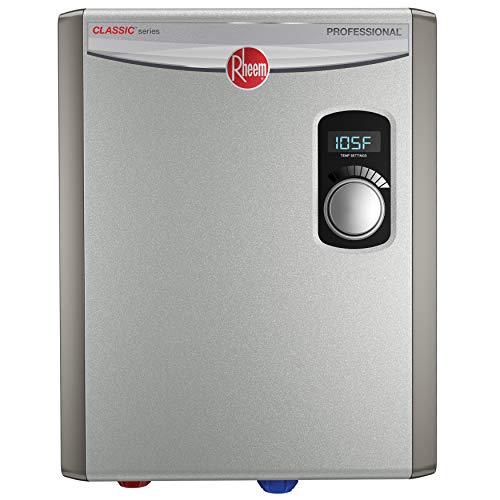
The Rheem 18kW 240V Tankless Electric Water Heater is an on-demand domestic water heating appliance built for residential installations needing steady hot water without the footprint of a traditional storage cylinder. Designed to activate only when a hot water fixture is opened, this system prevents the standby energy loss inherent to older tank units. It is well suited for homeowners, cabin owners, and property managers aiming to modernize utility closets or basement spaces with a compact wall-hung unit.
Heating operation relies on an 18kW electrical rating at 240V, delivering a listed flow rate of up to 4.4 gallons per minute (GPM). Performance is managed through self-modulating control circuitry that tracks demand and dynamically adjusts power to meet your chosen temperature. The exterior interface features a digital thermostatic control with an LED readout, offering target setting precision within plus or minus 1 degree so users can avoid unexpected temperature swings.
Inside the gray casing, heating is handled by two durable copper immersion elements. Copper provides dependable heat transfer into the moving water stream, and both elements are threaded into position for field serviceability. This design ensures that if mineral deposits or wear affect an element over time, it can be unthreaded and replaced independently without requiring the homeowner to swap out the entire appliance.
Weighing 14.78 pounds and measuring 18.5 by 14.5 by 3.5 inches, this small-format heater installs onto standard wall studs or flat vertical surfaces. Plumbing hookups use standard bottom 3/4-inch NPT water connections, providing an organized path for incoming cold and outgoing hot water lines. Because an 18kW 240V draw is substantial, prospective buyers should have their home electrical panel evaluated by a qualified electrician to confirm sufficient service amperage and breaker space prior to mounting.
A natural consideration with electric tankless systems is the temperature of the incoming water supply. While a flow rate of up to 4.4 GPM is possible under mild inlet water conditions, winter groundwater temperatures in northern regions require more heating energy, which will reduce the maximum simultaneous flow rate. Additionally, proper electrical infrastructure is mandatory, as this high-power appliance cannot run on standard 120V household outlets.
For households with compatible electrical service seeking to eliminate an aging water storage tank, the Rheem 18kW unit offers an efficient, space-conscious domestic heating solution. Its precise digital thermostat, self-modulating power logic, and field-serviceable copper elements provide reliable everyday hot water control in a neat, low-profile package.
Temperature management on the Rheem 18kW model centers on an external digital thermostatic control paired with a clear LED display. The interface allows users to dial in temperature targets with a manufacturer-rated accuracy of plus or minus 1 degree, eliminating the guesswork associated with standard mechanical dials.
Complementing the digital screen is self-modulating regulation that adjusts power consumption according to demand. By continuously measuring flow rate and temperature rise, the heater delivers consistent warmth to domestic fixtures while avoiding unnecessary energy use when water draw is minimal.
The Rheem 18kW tankless electric water heater requires a 240V electrical connection capable of handling an 18kW load. Homeowners should verify their main electrical panel capacity and consult local codes to ensure appropriate wiring and dedicated circuit breaker sizing before installation.
Plumbing connections are located at the bottom of the enclosure and feature standard 3/4-inch NPT threads. Measuring 18.5 x 14.5 x 3.5 inches and weighing just under 15 pounds, the unit mounts directly to wall studs, clearing up floor area previously occupied by a conventional storage tank.
Frequently Asked Questions
How do I determine the right flow rate or capacity for my household?
Calculate the total gallons per minute (GPM) of all fixtures you plan to run simultaneously. Standard showerheads use between 1.5 and 2.5 GPM, while kitchen faucets draw around 1.0 to 1.5 GPM. A 14kW to 24kW electric tankless water heater typically supplies between 3.3 and 5.9 GPM depending on incoming groundwater temperature. If incoming tap water is cold in northern regions, an on-demand unit requires more heating power to reach target temperatures.
What electrical requirements are necessary for a whole-home electric tankless water heater?
Whole-home electric tankless models require substantial electrical service panel capacity. For example, a 24kW unit like the Rheem RTEX-24 typically requires a 200-amp main panel, three 40-amp double-pole breakers, and three sets of 8 AWG copper conductors. Smaller 14kW models generally call for a dedicated 60-amp double-pole breaker and 6 AWG wiring on a 240-volt line. Verifying your breaker panel capacity before evaluating the Best Water Heater For Home avoids expensive electrical service upgrades.
Can a compact point-of-use water heater supply hot water for a shower?
No, most low-wattage 110-volt tankless units cannot supply sufficient flow for a standard shower. Typical residential showers require at least 1.8 to 2.0 GPM, whereas 3000W 110-volt tankless models produce less than 0.5 GPM at comfortable temperature rises. Compact point-of-use models are designed primarily for single-sink handwashing, kitchen sinks, or RV use. If you need shower hot water in a small footprint, consider a high-power 240-volt unit or a 12-to-18-gallon storage tank.
What is the main difference between tank storage and tankless electric water heaters?
Tankless water heaters heat incoming water on demand without keeping a reservoir hot, reducing standby heat loss. In contrast, storage tank heaters maintain a set water volume at constant temperature using internal heating elements and tank insulation. Tankless units save floor space with compact wall-mounted designs but demand much larger instantaneous electrical loads. Storage tanks deliver steady pressure across moderate usage periods on simpler 120-volt circuits.
How often do electric storage water heaters require maintenance?
Storage tanks generally require routine flushing once a year to clear sediment buildup. In areas with hard water, minerals settle along the bottom of the tank and coat immersion elements, slowing down recovery rates. Checking the sacrificial anode rod every one to two years helps protect the inner tank lining from corrosion and leaks. For tankless models, cleaning the inlet filter screen and periodic descaling helps maintain rated flow rates.
Can a 120-volt water heater work for whole-home demand in 2026?
No, standard 120-volt water heaters are generally intended for single fixtures, small cabins, or auxiliary point-of-use applications rather than multi-bath homes. Units running on 120 volts typically feature 1500W to 1600W elements, meaning recovery takes longer and simultaneous fixture demand quickly depletes hot water. If you are outfitting an outbuilding or detached garage with a 110v supplemental heater alongside a small plug-and-play water tank, dedicated branch circuits are essential to prevent overloads. For full residential hot water needs, a 240-volt storage tank or high-output tankless model remains the practical choice.






Write Your Review
No reviews yet. Be the first to share your experience!