


Winter camping and off-grid road trips demand a reliable heat source capable of handling freezing outdoor temperatures inside compact living quarters. Installing a dedicated diesel heater for van conversions allows travelers to maintain a stable indoor climate without draining house battery banks or dealing with the excessive interior moisture caused by portable propane warmers. Modern diesel parking heaters use forced-air combustion chambers that vent exhaust gases outside while circulating clean, dry warm air throughout the living space. Understanding the core distinctions between power ratings, fuel consumption rates, and control systems helps you choose an option that keeps your camper comfortable on every route. You can explore complementary concepts in our review of ventless heating safety principles to see why sealed combustion remains essential in enclosed spaces.
Modern enclosed parking units feature compact footprints, integrated fuel tanks, and low-draw electrical connections designed to operate from auxiliary battery banks or portable power stations. Whether you plan to sleep in sub-zero mountain passes or need reliable supplemental warmth during crisp autumn journeys, selecting the right heating configuration protects your plumbing lines and personal comfort. Comparing features such as automatic elevation adjustment, Bluetooth app integration, and dual-voltage power transformers ensures that your selected unit matches your specific travel habits. Taking time to inspect fuel line routing, mounting clearances, and power delivery guarantees dependable performance whenever cold weather sets in.
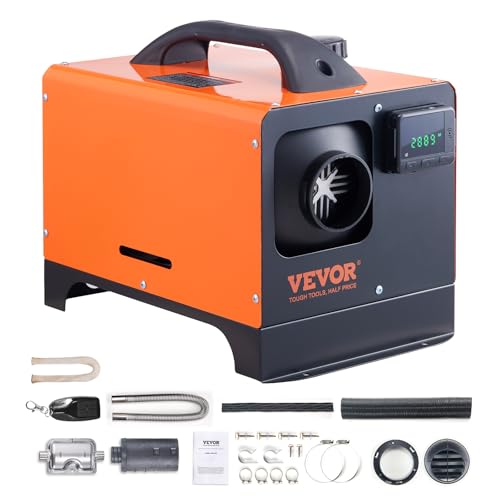
Pros
- Integrated all-in-one housing combines the fuel tank, pump, and heating core into a single portable unit without multi-part mounting.
- Convenient 32-foot wireless remote control lets users preheat vehicle or camper interiors from outside.
- Wide operating range down to -104 °F and up to 9,843 feet altitude supports reliable winter travel in mountain conditions.
- Overheat protection set at 518 °F and automated temperature regulation promote safe overnight use when installed with proper ventilation.
Cons
- Requires a constant 12V DC electrical connection alongside diesel fuel to power the internal fan, fuel pump, and electronics.
- Combustion exhaust and air intake require careful physical routing to ensure fumes exit safely away from enclosed living quarters.
- Carrying weight approaches roughly 28 pounds once the 1.3-gallon internal diesel tank is filled to capacity.
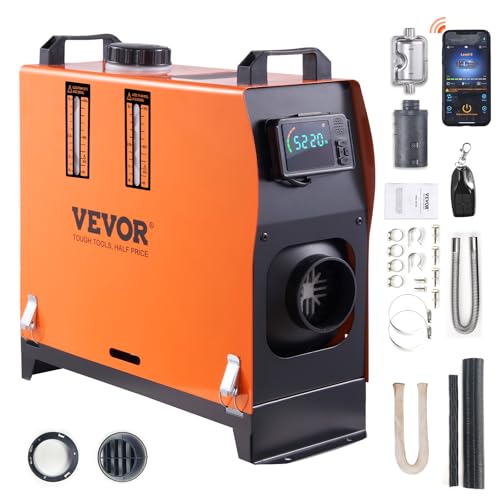
The VEVOR 12V 5KW All-in-One Diesel Air Heater is an integrated, self-contained forced-air parking heater designed primarily for mobile living quarters, camper vans, RVs, trucks, and enclosed utility spaces. Featuring a rugged orange steel-and-composite outer casing, this all-in-one unit houses the combustion burner, fuel dosing pump, and a 5-liter fuel reservoir within a unified footprint. For off-grid travelers and outdoor enthusiasts who need dry, efficient heat without tapping into an existing vehicle fuel line, this unit presents a self-sufficient heating alternative.
Heating performance centers around a 5 KW thermal output channeled through a sandblasting aluminum heat exchanger. The manufacturer specifies heating coverage between 161 and 215 square feet, bringing ambient temperatures up rapidly within a listed 10-minute window. Fuel efficiency remains economical during standard cycles, with consumption varying between 0.16 and 0.52 liters per hour depending on user demand. Supported by the built-in 5 L (1.3-gallon) tank, the unit can sustain continuous heat for up to 10 hours on a single fill, keeping mobile interiors comfortable through cold nights.
Operation and interface management are handled through dual digital options. The main console features a high-contrast LCD screen providing real-time data on operating status, timing functions, voice status broadcasts, and temperature regulation ranging from 46 °F to 96.8 °F (8 °C to 36 °C). For added convenience, a 32-foot long-distance remote control allows users to initiate heating cycles from outside the vehicle, helping to preheat the living area or defrost windows before stepping inside.
Setup requires both a 12V DC power supply to run the internal blower and glow plug, as well as exterior venting for the combustion intake and exhaust piping. The heater is built to operate under severe climate conditions, rated for ambient temperatures ranging from -104 °F to 104 °F (-40 °C to 40 °C) and working reliably at altitudes up to 9,843 feet (3,000 meters). From a safety perspective, the system incorporates constant temperature modulation and an automatic overheat shutoff threshold triggered at or above 518 °F (270 °C).
While the all-in-one form factor eliminates the hassle of mounting separate fuel tanks and pumps, combustion heaters demand strict installation hygiene. Safe operation strictly requires venting the exhaust pipe outside any enclosed sleeping quarters to completely mitigate carbon monoxide risks. Additionally, while the unit weighs an accessible 19.73 pounds empty, adding 1.3 gallons of diesel adds weight, and users must account for the continuous 12V draw on their auxiliary battery bank during extended runtimes.
For owners of overland vehicles, camper vans, or workshop trailers seeking an accessible, self-contained heating solution, this VEVOR 5KW model provides substantial warmth and low fuel consumption. As long as users adhere strictly to manufacturer ventilation guidelines and secure a stable 12V electrical source, it represents a capable and cost-effective heating option for cold-weather adventures.
This heater runs exclusively on diesel fuel, utilizing an integrated 5-liter (1.3-gallon) storage reservoir built directly into the housing. A precision low-noise dosing pump meters fuel smoothly at rates between 0.16 and 0.52 liters per hour, which equates to roughly one gallon across an overnight cycle depending on selected warmth levels.
The self-contained tank design eliminates the need to splice into a vehicle's primary fuel system, making it an attractive setup for temporary installations or secondary recreational vehicles. Users should always ensure clean diesel is added and monitor fuel levels before heading into remote locations.
The VEVOR diesel heater includes both an onboard digital LCD screen and a wireless remote with an operating range of up to 32 feet. Users can adjust target temperatures between 46 °F and 96.8 °F, program operational timers, and monitor live operating parameters directly from the screen.
Audible voice broadcasting alerts the user to system changes, while the remote allows drivers or campers to start preheating their vehicle from a distance. The internal electronics ensure consistent temperature cycling rather than abrupt on-and-off temperature spikes.
Combustion air heating requires strict adherence to manufacturer safety instructions. The combustion exhaust pipe must be securely routed outdoors to vent exhaust gases, and all intake ports must remain clear of obstructions at all times.
The heater is equipped with integrated overheat protection that triggers an automatic shutdown if internal operating temperatures reach or exceed 518 °F (270 °C). The unit also features preheating cycles and steady electronic temperature regulation to protect internal components across extreme conditions ranging from -104 °F to 104 °F.

Pros
- Operates on multiple electrical sources including 12V vehicle batteries, 24V systems, and 110V wall outlets
- Bluetooth smartphone app enables remote temperature adjustments and timer scheduling from up to 98 feet away
- Economical 0.04 to 0.1 gal/h fuel burn rate supports all-night heating from the 1.3-gallon internal tank
- Upgraded safety protections include a carbon monoxide alarm, overheat cutoff at 518°F, and reverse polarity defense
Cons
- Requires careful routing and secure exterior venting of combustion exhaust fumes before use in any enclosed space
- Carrying the 23.37-pound dry unit becomes significantly heavier once the 1.3-gallon tank is filled with fuel
- Manufacturer-listed coverage of 108 to 161 square feet is best suited for compact spaces rather than large uninsulated workshops
The VEVOR 8KW All-in-One Diesel Heater is an enclosed, fuel-burning forced-air heater engineered for portable and semi-permanent use in camper vans, RVs, trucks, rooftop tents, and detached garages. Designed for cold-weather travelers, outdoor enthusiasts, and workshop hobbyists, this unit consolidates the fuel tank, pump, combustion assembly, and electronics into a single self-contained gray housing. It suits buyers seeking an alternative to high-draw electric space heaters or propane units, delivering dry heated air without putting severe demands on campsite electrical circuits.
In terms of heating performance, the manufacturer rates this diesel unit at 8KW of thermal output, with listed coverage spanning 108 to 161 square feet. According to product specifications, it can produce warm air reaching up to 210°F within five minutes and warm a vehicle interior in approximately ten minutes. Thermostat controls allow target temperature settings from 46.4°F to 96.8°F. Because it consumes diesel at a rate of 0.04 to 0.1 gallons per hour with over 90% listed efficiency, the integrated 1.3-gallon fuel tank supports all-night operation during winter excursions without requiring mid-sleep refills.
The all-in-one chassis measures 16.73 by 12.6 by 12.2 inches and weighs 23.37 pounds, enclosing an LCD display, electronic control board, and fuel system within a structured shell. User control is straightforward, allowing adjustments via the onboard screen, the included handheld remote, or a Bluetooth smartphone app operating at distances up to 98 feet. Safety measures include an internal carbon monoxide (CO) alarm, an exhaust pipe heat sleeve, a sealed fuel cap, overvoltage defense, reverse polarity protection, and an internal circuit board programmed for automatic overheat shutdown at temperatures of 518°F or higher.
Setting up this diesel heater requires mindful placement, secure electrical connections, and strict exhaust management. Because combustion produces exhaust gases, the metal exhaust pipe must always be directed safely outside living and working quarters, using the supplied heat sleeve to shield nearby surfaces. Power flexibility is a strong highlight, as the unit accepts 12V DC, 24V DC, or standard 110V AC wall power without needing external transformers. It is also rated to operate at elevations below 9,842 feet, making it suitable for mountain campsites and high-altitude travel.
Prospective buyers should evaluate a few practical limitations before purchasing. Safe combustion venting is non-negotiable, meaning the heater cannot simply be placed indoors without routing exhaust completely outdoors. Additionally, while the 23.37-pound dry weight is manageable, adding 1.3 gallons of diesel adds noticeable heft during transport. The manufacturer-listed coverage of 108 to 161 square feet makes it ideal for vehicle cabins, small trailers, and compact work bays, but larger or drafty garages may require additional air circulation.
For camper van builders, truck drivers, overlanders, and garage hobbyists seeking dependable heat away from the power grid, the VEVOR 8KW diesel heater represents a practical and cost-conscious choice. Its tri-power compatibility across 12V, 24V, and 110V power sources simplifies setup across different environments, while the inclusion of app management and dedicated safety shutoffs provides modern operating convenience when installed and vented according to manufacturer directions.
The VEVOR 8KW diesel heater features multi-voltage versatility, operating on 12V or 24V direct current from vehicle batteries as well as standard 110V alternating current household outlets. This flexibility allows users to run the unit from an auxiliary battery bank off-grid or plug directly into a wall receptacle inside a garage or shed.
Fuel efficiency is supported by a quiet, metered fuel pump that consumes between 0.04 and 0.1 gallons of diesel per hour with a listed combustion efficiency exceeding 90%. Paired with the onboard 1.3-gallon diesel reservoir, the heater supports extended all-night heating cycles without requiring constant monitoring or frequent refueling.
Operational control is managed through three distinct interfaces: an integrated LCD screen on the heater body, an included handheld remote control, and a Bluetooth smartphone application with a transmission range of up to 98 feet. The Bluetooth app enables users to preheat cold interiors, configure operating timers, and adjust target temperatures between 46.4°F and 96.8°F directly from a mobile device.
An altitude operating capability rated up to 9,842 feet ensures that the fuel-to-air combustion mixture remains functional across high-elevation travel destinations without high-altitude stalling.
Combustion safety requires proper planning, and this VEVOR model integrates a carbon monoxide alarm, a sealed fuel cap to minimize vapor leakage, and a specialized heat sleeve for the exterior exhaust pipe. The internal control board features built-in reverse polarity prevention, overvoltage management, and an automatic overheat cutoff that activates if temperatures reach or exceed 518°F.
Because diesel combustion generates exhaust gases, this heater must always have its exhaust piping safely vented directly outside the vehicle, tent, or workspace. Users should adhere to manufacturer clearance guidelines, keep intake and exhaust pathways unobstructed, and maintain adequate fresh-air ventilation during operation.

Pros
- Included 110V transformer allows direct connection to standard household electrical sockets without purchasing an aftermarket converter
- Wide thermal output ranging from 4,700 to 17,000 BTU handles mild damp chills as well as extreme sub-zero weather down to -40°F
- Internal-threaded fuel cap prevents diesel spills and reduces fuel vapor odors during vehicle movement
- Comes with a pre-paired remote control operating up to 100 feet away for easy adjustments from across a room or vehicle
Cons
- Combustion operation requires strict adherence to manufacturer instructions regarding outside exhaust ducting and fresh air intake
- At 26 pounds empty, the unit becomes noticeably heavier to move once the 5-liter internal fuel reservoir is filled
- Requires ongoing diesel fuel management and basic combustion system upkeep compared to standard plug-in electric heaters
The LF Bros 5KW Diesel Air Heater is a self-contained, all-in-one forced-air heating unit built for owners of RVs, camper vans, workshops, trailers, and detached garages who need dependable warmth in severe winter climates. Unlike standard electric portable heaters that depend entirely on heavy household electrical current, this diesel-fueled system produces substantial dry heat while drawing minimal electrical power to operate its internal pump, fan, and control circuitry. The system is especially appealing for users who transition between mobile off-grid environments and stationary buildings because it includes a factory 110V transformer alongside standard 12V and 24V direct-current compatibility.
Heating performance centers around a 5-kilowatt burner capable of producing between 4,700 and 17,000 BTU of dry, forced-air heat. The system adjusts fuel delivery between 0.18 and 0.53 liters per hour depending on heating demands, allowing users to balance diesel consumption against outdoor temperature swings. Engineered to function in severe conditions ranging from -40°F up to 104°F, this heater delivers continuous forced warm air that effectively prevents cabin freeze-up and cuts through interior dampness. Actual heating comfort will vary based on insulation levels, ceiling height, and enclosure drafts, but the adjustable BTU output gives users flexible control over varying space sizes.
Build quality is highlighted by a compact, two-tone black and white chassis measuring 15 by 9.6 by 11.6 inches that encloses the burner, combustion blower, and fuel reservoir into a single structure. A notable design element is the 5-liter fuel tank cap, which features an internal automotive-style thread. This threaded design seals tightly to prevent fuel sloshing or leaking while traveling over rough terrain, addressing a frequent issue found on budget all-in-one heaters. Weighing approximately 26 pounds before fuel is added, the housing is sturdy enough for shop floors or camper compartments while keeping all vital mechanical components protected inside.
Operation and system setup are straightforward thanks to the included hardware, an LCD control switch, and a pre-paired remote control with an operating range of up to 100 feet. The LCD panel provides real-time operational status, while the remote allows convenient temperature and mode adjustments from across a camper bed or workshop bench. The package includes an instruction booklet and a QR code linking to an installation tutorial. Because this is a combustion appliance, safe installation strictly requires routing the exhaust pipe completely outside the living or working space, ensuring unrestricted combustion air intake, and adhering to all manufacturer clearance instructions.
A realistic evaluation reveals that while the LF Bros heater is remarkably versatile, it requires more setup diligence than a standard electric space heater. The unit requires proper ventilation, dedicated fuel handling, and careful exhaust pipe placement away from combustible surfaces or entry points. Additionally, while the 26-pound dry weight is manageable, filling the 5-liter fuel tank adds noticeable weight, making frequent manual relocation between sites less practical once the tank is topped off. The unit also requires a reliable 12V, 24V, or 110V power source to maintain the glow plug, fan, and fuel metering pump.
For homeowners, vehicle builders, and outdoor hobbyists seeking potent supplemental heat without overloading household electric circuits, the LF Bros 5KW All-in-One Diesel Heater provides an exceptional balance of power and convenience. The inclusion of an out-of-the-box 110V adapter eliminates the need to wire custom power converters for garage or basement use, while its native 12V/24V capability preserves off-grid vehicle readiness. When installed in accordance with proper exhaust and ventilation guidelines, it serves as a highly capable cold-weather heating companion.
The LF Bros 5KW Diesel Heater stands out for its versatile triple-voltage electrical configuration. In addition to standard 12V and 24V direct-current connections suited for camper vans, overland trucks, and marine battery systems, this unit includes a dedicated 110V AC transformer. This allows users to plug the heater directly into standard 110-volt household or workshop wall outlets without purchasing third-party power adapters or doing complex custom electrical wiring.
Fuel efficiency is driven by a precision metering system that consumes between 0.18 and 0.53 liters of diesel per hour across its 4,700 to 17,000 BTU operating span. Paired with the internal 5-liter fuel tank, the heater can sustain long periods of steady warmth before requiring a refill. The threaded, leak-resistant cap helps maintain clean operation during vehicle transport, preventing diesel odors and spills inside enclosed trunks or camper interiors.
Because the LF Bros 5KW heater operates via diesel combustion, safe venting is the single most critical aspect of the installation process. The heater generates carbon monoxide and hot exhaust gases during operation, requiring the exhaust pipe to be routed strictly to the outdoors away from doors, windows, and vehicle ventilation intakes. Users must never operate the combustion exhaust inside an unvented enclosed living or working area.
Installation guidance is supported by a comprehensive user manual and a scannable QR code directing buyers to an instructional video tutorial. Proper placement requires firm, level mounting and adherence to manufacturer clearance guidelines surrounding the hot exhaust tubing and heated-air outlet. Maintaining an unobstructed cold-air return path and routing fresh combustion intake air properly ensures clean, reliable burning even in sub-zero winter environments down to -40°F.
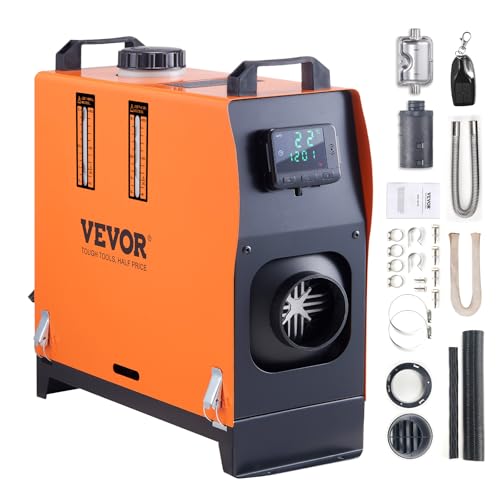
Pros
- Integrated all-in-one metal chassis combines tank, pump, and burner to eliminate loose component mounting.
- Wide operating temperature range from -104 °F to 104 °F and altitude tolerance up to 9,843 feet.
- Convenient dual control system allows temperature adjustments from up to 32 feet away via remote.
- Low fuel burn rate allows up to 10 hours of heating per 5-liter tank of diesel.
Cons
- Requires a 12V DC power source or dedicated battery to run the internal fan, glow plug, and controls.
- Requires careful exhaust pipe ducting to the outdoors to ensure combustion fumes do not accumulate inside living spaces.
- Manufacturer-rated heating range of 161 to 215 sq ft is intended for compact vehicles or small spaces rather than whole buildings.
The VEVOR 12V 5KW All-in-One Diesel Air Heater is an integrated, self-contained forced-air system built for campervans, RVs, travel trailers, boat cabins, and small outbuildings. By integrating the burner core, fuel pump, fan mechanism, and 5-liter (1.3-gallon) fuel tank into a single bright orange metal body, this heater eliminates the hassle of separate tank mounting and complex fuel line routing. For outdoor adventurers and off-grid builders facing freezing weather, it offers powerful independent heat whenever a standard 12V DC electrical supply is available.
Heating performance centers around a 5 KW burner connected to a sandblasting aluminum heat exchanger. The manufacturer notes rapid heat transfer within roughly 10 minutes of startup, warming the ambient air quickly as the fan circulates warmth. With a rated coverage range of 161 to 215 square feet (15 to 20 square meters), this unit is sized appropriately for cargo van builds, overland setups, truck caps, and drafty workshop corners. The unit burns between 0.16 and 0.52 liters of diesel per hour, delivering up to 10 hours of continuous heating on a single fill depending on your chosen thermostat setpoint.
The build quality reflects a practical, utility-first approach. Measuring 15 by 5.9 by 16.1 inches and weighing 18.3 pounds, the compact unit includes an integrated top handle for moving it between work areas or transport vehicles. Its internal precision fuel pump is engineered for low-noise pulsing compared to older aftermarket designs. On the safety front, the electronics include automatic overheat protection that activates if internal components reach or exceed 518 °F (270 °C), alongside timed shutdown options, voice broadcasting alerts, and constant temperature maintenance.
Managing interior comfort is simple with the included dual-control setup. An onboard LCD panel displays operational parameters, while a wireless remote control provides temperature adjustments from up to 32 feet away across a span of 46 °F to 96.8 °F (8 °C to 36 °C). Because this is a combustion heater, proper placement is critical. Users must set the chassis on a level surface and securely route the intake and hot metal exhaust piping directly to the exterior of the vehicle or structure to keep combustion fumes safely outdoors.
Buyers should also be mindful of practical operational limits. Even though this heater runs on diesel fuel, it still depends on an external 12V DC battery or power supply to operate the digital interface, combustion fan, and internal glow plug during startup and shutdown. Additionally, while the 161 to 215 square foot rating covers camper interiors well, it is not built for large multi-room spaces or uninsulated pole barns. Care must also be taken when filling the top-mounted diesel reservoir to prevent spills inside tight quarters.
Overall, the VEVOR 5KW diesel air heater provides reliable, cost-effective supplemental heat for cold-weather camping and off-grid work. Its broad ambient operating envelope down to -104 °F and altitude rating up to 9,843 feet make it an adaptable winter heating tool. When wired to a stable 12V power source and installed with proper outdoor exhaust ventilation, it offers dependable warmth in challenging environments.
The VEVOR 5KW diesel heater provides reliable thermal output with a low consumption rate ranging from 0.16 to 0.52 liters of diesel per hour. Equipped with an internal 5-liter (1.3-gallon) fuel reservoir, it can run continuously for up to 10 hours before requiring a refill, depending on the target temperature set on the controller.
A sandblasting aluminum heat exchanger accelerates warmth transfer, allowing the unit to deliver noticeably hot airflow within approximately 10 minutes of starting. The combustion system is also engineered to perform under demanding conditions, operating reliably in surrounding temperatures between -104 °F and 104 °F and at altitudes up to 9,843 feet.
Dual control options include a high-visibility LCD screen and a long-range wireless remote functioning up to 32 feet away. Users can adjust target temperatures between 46 °F and 96.8 °F (8 °C to 36 °C), configure preheat cycles, and set shutoff timers directly from inside a vehicle or sleeping quarters.
For operational safety, the heater includes an internal overheat protection system that automatically triggers if temperatures reach or exceed 518 °F (270 °C). Voice broadcasting updates inform users of heater status, while the thermostat maintains consistent heating. Because this unit produces combustion gases, strict adherence to outdoor exhaust routing instructions is required for safe operation.
The all-in-one configuration houses the burner, pump, and fuel supply within a 15 by 5.9 by 16.1 inch chassis, significantly simplifying setup compared to component kits. Weighing 18.3 pounds, the heater is relatively easy to position on flat, stable surfaces in trailers, truck beds, or work areas.
Every installation requires an external 12V DC power source to run the internal fan, fuel metering pump, and control display. Combustion air intake and hot exhaust pipes must be firmly clamped and directed outside the vehicle or living space to maintain clean, safe indoor air quality.
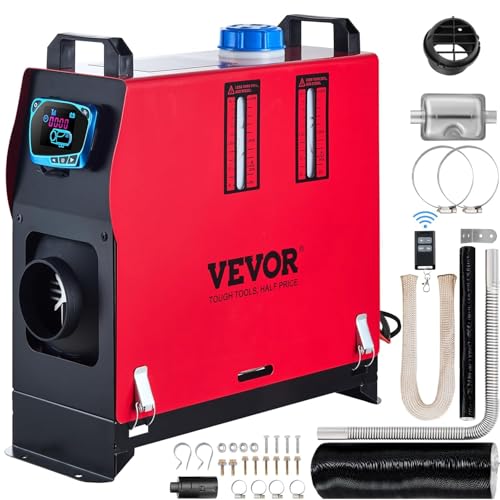
Pros
- All-in-one enclosed layout measures 16.22 x 7.09 x 16.14 inches for simplified placement in campers, cargo beds, or utility compartments.
- Consumes a modest 0.18 to 0.36 L/h of diesel, allowing extended overnight heating from the onboard 5-liter fuel reservoir.
- 98-foot remote control lets users trigger pre-heating from outside the vehicle to clear frost before entry.
- Engineered to maintain combustion stability at elevations up to 9,843 feet without complex manual adjustments.
Cons
- Requires complete exterior exhaust venting and proper clearance to discharge combustion gases safely outside the living space.
- Needs a dedicated DC 12V or 24V battery supply and cannot plug directly into a standard 120V household wall outlet without an external AC-to-DC converter.
- Not intended for unvented residential living rooms or indoor household bedroom heating.
The VEVOR 8kW Diesel Air Heater is an autonomous, forced-air parking heater tailored for mobile living spaces, overland builds, and commercial utility vehicles. Running on direct-current 12V or 24V electrical connections, this unit is engineered for owners of camper vans, RVs, travel trailers, sleeper cabs, and boats who need a dependable heat source independent of AC shore power or central propane lines. For travelers dealing with cold shoulder seasons or sub-freezing winter journeys, it provides focused thermal output specifically suited for enclosed spaces between 161 and 215 square feet.
Heating performance centers on an 8 kW internal combustion burner fitted with a rapid ceramic igniter for dependable cold-weather ignition. The heater draws from its built-in 5-liter (1.3-gallon) fuel tank via a precision low-noise fuel pump, maintaining a consumption rate between 0.18 and 0.36 liters per hour. According to manufacturer specifications, this combustion system delivers greater than or equal to 90 percent combustion efficiency, which translates to approximately one gallon of diesel consumed over a typical full night of runtime. This low fuel consumption rate allows users to maintain steady cabin temperatures through extended overnight stops without requiring frequent mid-trip refills.
Temperature regulation is managed through dual control options, giving owners flexibility whether resting inside or approaching the vehicle from a distance. The unit comes equipped with a 98-foot wireless remote control with pre-heating capabilities, letting users warm the cabin and defrost windows before entering. Inside, the blue LCD control switch allows users to monitor operational status and set target temperatures anywhere between 32 degrees and 104 degrees Fahrenheit. Additionally, the combustion design maintains stable operation at high elevations up to 9,843 feet, addressing a common failure point found in entry-level mobile heating equipment.
The physical construction utilizes an all-in-one red housing measuring 16.22 inches long, 7.09 inches wide, and 16.14 inches tall, weighing in at 18.3 pounds. To mitigate operational hazards common to diesel combustion units, VEVOR integrates an insulated exhaust pipe shield to help prevent scorching nearby vehicle bodywork or accidental contact burns. A leak-proof fuel cap helps contain liquid diesel on uneven roads and undulating terrain, while an onboard fuel gauge helps users monitor fluid levels to prevent dry burning and potential flameout issues.
Despite its convenience, prospective buyers should recognize the inherent installation and operational considerations of combustion equipment. Because the unit burns diesel fuel, the exhaust system must be routed completely outside the vehicle using heat-resistant metal ducting and proper exterior clearances to keep toxic combustion byproducts out of the living area. The heater also requires a sustained DC 12V or 24V power supply to run the electronics, ceramic igniter, and circulation fan, meaning it cannot simply be plugged into a standard 120V residential wall outlet. As a result, it is not suitable as a freestanding indoor home space heater.
For owners of conversion vans, overland rigs, commercial trucks, and boat cabins looking for an economical, fuel-efficient thermal system, this 8 kW parking heater delivers strong utility. Combining remote preheating functionality, elevation tolerance up to nearly 10,000 feet, and low hourly diesel consumption, it serves as a practical, off-grid heating upgrade for cold-weather road travel.
The VEVOR 8kW Diesel Air Heater features a versatile dual-control system consisting of an onboard blue LCD display screen and an extended-range wireless remote. The LCD interface allows operators to adjust the internal thermostat across a wide temperature range from 32 degrees to 104 degrees Fahrenheit, helping maintain consistent cabin comfort based on changing weather conditions.
The included remote control functions up to a distance of 98 feet, enabling convenient pre-heating functionality from outside the vehicle or campsite. This allows users to start the combustion sequence ahead of time, ensuring the cabin is pre-warmed and window frost is reduced prior to driving. The integrated electronic controller also automatically manages the ceramic igniter and fuel pump cadence to maintain combustion stability across varying altitude demands up to 9,843 feet.
This heater operates exclusively on standard diesel fuel stored within its integrated 5-liter (1.3-gallon) internal fuel reservoir. A precision-metered, low-noise fuel pump delivers a controlled fuel flow between 0.18 and 0.36 liters per hour, yielding an estimated consumption of approximately one gallon per night depending on the chosen thermostat setpoint.
Electrical power must be supplied by a DC 12V or DC 24V system, making it directly compatible with dual-voltage automotive batteries, auxiliary RV house battery banks, or mobile solar power stations. An external power source is necessary to operate the ceramic igniter during startup and to continuously power the LCD display, internal sensors, and forced-air blower fan during heating cycles.
Safe installation of the VEVOR Diesel Air Heater requires rigid adherence to combustion venting guidelines. The combustion intake and hot exhaust pipe must be securely ducted to the exterior of the vehicle or enclosure, utilizing the included heat-insulated exhaust shield to protect surrounding structural components from excessive heat and to reduce contact burn hazards.
The unit incorporates a leak-proof fuel cap to prevent spills during vehicular transit over rough terrain, along with an integrated fuel gauge that allows quick visual level checks to prevent dry-burning situations. Because this device combusts diesel fuel, it should never be operated in an unvented indoor room or residential space, and vehicle installations should always be paired with a functional carbon monoxide detector inside the living area.

Pros
- Multi-voltage compatibility allows seamless switching between camper battery banks (12V/24V) and garage AC wall power (110V/240V).
- Substantial 8KW maximum thermal output generates prompt, dry air heat for chilly outdoor cabins, camper builds, and service bays.
- Large 8-liter internal fuel reservoir eliminates the mess and complexity of mounting external fuel tanks.
- Included LCD controller, wireless remote, preheat function, and exhaust muffler provide complete operational control right out of the box.
- Threaded anti-leak fuel port prevents messy diesel spills during transport on bumpy roads.
Cons
- Requires careful outdoor exhaust pipe routing and proper combustion ventilation before operating in any enclosed structure.
- Fuel consumption scales noticeably under maximum load, ranging from 0.16 liters up to 0.62 liters per hour.
- Weighs significantly more when the 8-liter fuel tank is filled to capacity, reducing grab-and-go portability.
The RDXTIK 8L 8KW All-in-One Diesel Heater is engineered for vehicle dwellers, overlanding campers, and garage mechanics who need robust, dry forced-air heating without complicated component assembly. Unlike traditional split-system parking heaters that require mounting a separate fuel tank, fuel pump, and burner unit, this model houses all essential mechanical components inside a unified white metal chassis. For users seeking supplemental heat across varied environments, its self-contained configuration significantly simplifies transport and seasonal setup.
Heating capability centers on an 8000W diesel combustion core managed by a digital thermostat covering 46.4°F to 96.8°F (8°C to 36°C). The heater draws fuel from its built-in 8-liter tank via an internal low-noise pump, consuming between 0.16 and 0.62 liters of diesel per hour depending on heating demand. Under moderate settings, the manufacturer lists runtimes reaching up to 24 hours on a single fill, roughly equating to about one gallon across an overnight cycle. Users can regulate output directly via the mounted LCD screen or adjust heat levels from across the room using the supplied wireless remote control.
Electrical adaptability represents one of the standout aspects of this RDXTIK heater. While standard diesel air heaters are strictly restricted to 12V or 24V direct current, this model includes an integrated 110V to 240V AC power converter alongside standard DC leads. This allows owners to plug the unit straight into a typical home or garage outlet when working inside a workshop, or connect it directly to deep-cycle house batteries when parked off-grid in an RV, truck cab, or camper.
Installation versatility is aided by two swappable base configurations: a vibration-dampening rubber bottom and a rigid metal mounting base. Safety provisions include an internal thermal limit switch that triggers an automatic shutdown if internal operating temperatures meet or exceed 518°F (270°C). Furthermore, the fuel tank neck features an internal threaded design paired with a heavy-duty rubber O-ring to prevent diesel seepage while driving over rough trails.
Prospective buyers must recognize the combustion realities of any diesel-fired system. Although marketed for applications spanning vehicles, campers, and home spaces, this unit produces hot exhaust gases that must always be vented completely outdoors via the included exhaust pipe and muffler. It cannot be used as an unvented indoor room heater. Additionally, while the fuel pump features low-noise dampening, light pulsing sounds and fan movement remain noticeable during high-output operation.
For owners of conversion vans, overland rigs, detached workshops, and travel trailers, the RDXTIK 8L 8KW Diesel Heater offers exceptional value. Its built-in tank, bundled dual-voltage power supply, and straightforward digital controls make it a practical, high-output heating solution that avoids the complex installation hurdles of conventional split diesel systems.
Power supply flexibility is where the RDXTIK diesel heater distinguishes itself from conventional mobile heaters. The unit is pre-wired to accept both 12V and 24V direct-current systems, making it natively compatible with passenger vehicles, work trucks, boats, and off-grid solar battery banks. When connected to a standard 12V auxiliary system, it draws power to run the internal glow pin during ignition and sustain the combustion fan and low-pulse fuel pump throughout operation.
In addition to battery power, the package includes an AC adapter supporting 110V to 240V household current. This transformer allows users to run the heater directly from standard electrical outlets without purchasing aftermarket converters, making it just as convenient for backyard sheds and detached garages as it is for mobile camper setups. Paired with an internal 8-liter diesel tank that burns approximately 0.16 to 0.62 liters per hour, this unit delivers consistent heat across diverse power environments.
Because the RDXTIK heater generates heat through internal diesel combustion, safe venting practices are strictly mandatory. The combustion chamber takes in air from an intake pipe and discharges exhaust gases through a dedicated metal exhaust tube equipped with a muffler. These exhaust components become hot during use and must always exit directly to the open outdoor air, safely isolated from vehicle interiors, living spaces, and flammable materials.
The unit incorporates an overheat safety sensor that shuts down the burner if core temperatures reach 518°F (270°C). To ensure longevity and reliable operation, users should keep the hot-air ducting free of kinks, maintain proper clearance around the metal cabinet, and verify that the fuel fill cap gasket is properly seated before transit. Always operate a functional carbon monoxide alarm in any enclosed space where fuel-burning appliances are running nearby.

Pros
- Automatic altitude compensation maintains clean combustion up to 18,045 feet without manual carburetor or pump adjustments.
- Multiple control methods allow preheating from a smartphone via Bluetooth, handheld remote, or the digital LCD display.
- Low fuel consumption of 0.12 to 0.26 L/h pairs with a large 10-liter tank for long runtimes up to 38 hours.
- Compact 11-pound design easily integrates into camper van builds, truck campers, and boat cabins.
Cons
- Requires specialized installation with direct-through exterior venting for combustion intake and exhaust piping.
- The 2 KW heating output is specifically designed for compact areas up to 161 sq ft and is not suited for large or uninsulated spaces.
- Requires a stable 12V DC power source and regular fuel line maintenance to ensure reliable ignition.
The VEVOR Bluetooth App Control 2KW Diesel Air Heater is a dedicated 12V forced-air heating system engineered primarily for camper vans, RVs, travel trailers, boats, and compact spaces. Designed for mobile living and off-grid applications where standard 120V household power is unavailable, this unit runs on direct-current 12V power paired with diesel fuel to generate continuous dry warmth. It suits overland travelers, winter campers, van converters, and workshop owners looking for reliable supplemental heat without relying on grid electricity or heavy propane tanks.
Heating performance is driven by a 2 KW thermal output, which the manufacturer rates for spaces between 108 and 161 square feet. Warm air production is assisted by a sandblasted aluminum heat exchanger designed for rapid heat transfer, which the manufacturer states can bring an enclosed cabin to a comfortable temperature within 10 minutes. Temperature management is flexible, offering control via an onboard LCD panel, an included 32-foot wireless remote, or a Bluetooth smartphone app functional up to 98 feet away. Users can set target temperatures between 46 °F and 96.8 °F (8 °C to 36 °C) to match changing weather conditions.
The build features a compact housing measuring 13.4 by 4.5 by 5.5 inches with a total weight of 11 pounds, allowing convenient placement beneath passenger seats, storage compartments, or furniture bases. A standout engineering feature is the built-in automatic altitude compensation, which regulates the combustion mixture at elevations up to 18,045 feet (5,500 meters) to prevent sooting and flameouts. Fuel delivery is handled by a precision low-noise metering pump that consumes between 0.12 and 0.26 liters of diesel per hour. When connected to the supplied 10-liter (2.6-gallon) fuel tank, the heater can achieve continuous runtimes up to 38 hours while using less than one gallon across an entire night.
Installation and daily handling require mechanical and electrical preparation compared to plug-in portable heaters. The unit must be connected to a reliable 12V power supply, such as an auxiliary deep-cycle or lithium battery, along with secure fuel routing. Because internal combustion produces harmful exhaust gases, strict adherence to manufacturer guidelines is necessary: combustion air intake and exhaust pipes must route completely outside the living compartment through sealed floor or wall penetrations. Safety systems include an automatic overheat shutoff that activates at or above 518 °F (270 °C), preheating status checks, an operating timer, and voice-assisted diagnostic broadcasts.
Realistic limitations should be factored in before purchase. This heater is not a freestanding plug-and-play appliance and demands careful DIY or professional installation, including drilling mounting holes and running exhaust hardware. While the manufacturer lists indoor use, running any diesel combustion device indoors requires strict, airtight exterior venting to prevent dangerous exhaust accumulation in the room. Additionally, the 2 KW output is matched strictly to small footprints; larger multi-room RVs or poorly insulated structures will need a higher-capacity heating unit.
For owners of camper vans, truck campers, overlanding rigs, and small utility cabins needing dependable off-grid heating, the VEVOR 2KW Diesel Air Heater is a practical, value-packed option. Its inclusion of Bluetooth remote preheating, a large fuel reservoir, and automated altitude correction resolves many common pain points associated with high-elevation and cold-weather adventures.
Control convenience is a core feature of this VEVOR 2KW diesel heater, which incorporates a three-way user interface. Owners can manage settings via the onboard LCD screen, use the included wireless remote control from up to 32 feet away, or connect through a smartphone Bluetooth application with a range up to 98 feet. This app capability allows users to preheat a vehicle or cabin from inside a sleeping bag or before entering from the cold. The system supports temperature adjustments from 46 °F to 96.8 °F (8 °C to 36 °C), alongside timer scheduling and real-time operational status updates.
Travelers navigating mountainous terrain will benefit from the automatic altitude compensation system, operational up to 18,045 feet (5,500 meters). The unit's internal controller detects elevation changes and automatically adjusts the fuel pump rate and combustion airflow. This automated regulation prevents carbon buildup and combustion errors common in non-compensating heaters when traveling across high mountain passes.
Fuel efficiency is anchored by a precision-metered, low-noise fuel pump that keeps diesel consumption between 0.12 and 0.26 liters per hour. According to the manufacturer, this allows the unit to consume less than 1 gallon of diesel per night during typical operation. Paired with the provided 10-liter (2.6-gallon) fuel tank, the heater can deliver continuous warmth for up to 38 hours before needing a refill, making it suitable for multi-day off-grid camping trips.
Electrical operation relies on a 12V direct-current power supply to run the internal glow pin, combustion blower, circulating fan, and digital control circuits. Electrical demand is highest during the startup preheating phase while the glow pin ignites the diesel fuel, after which the draw drops to a lower level needed to power the fan and fuel pump. This low-voltage requirement allows straightforward integration with standard 12V automotive batteries, RV house banks, or compatible portable power stations.
Proper installation requires adherence to manufacturer safety instructions regarding combustion intake and exhaust management. Because combustion happens in an enclosed chamber, the intake and exhaust pipes must pass securely through the vehicle or structure floor into the open outside air. Tight, leak-free exhaust clamps and proper clearances from heat-sensitive materials are mandatory to ensure that exhaust gases do not enter enclosed living spaces, and using an independent carbon monoxide detector in the space is strongly recommended.
Safety engineering includes an integrated overheating protection system programmed to initiate a shutdown if internal temperatures hit or exceed 518 °F (270 °C). The heater also features preheating monitoring, continuous temperature control, and voice-assisted diagnostic broadcasts to notify users of system status and ensure reliable operation throughout the night.
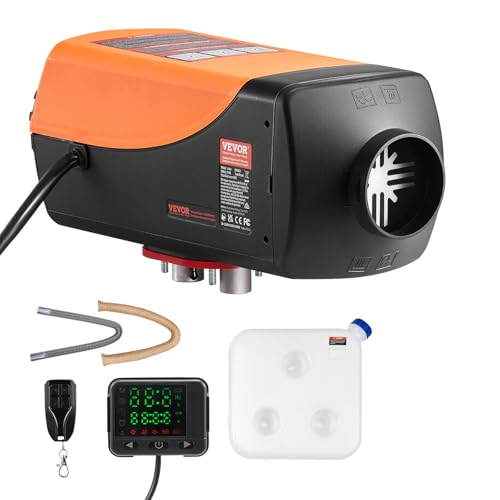
Pros
- Wide temperature control range from 46°F to 97°F with a 98-foot remote for convenient preheating.
- Generous 10L fuel tank capacity pairs with modest 0.18-0.37 L/h fuel consumption for extended overnight heating.
- Multi-voltage DC 12V-24V compatibility supports diverse automotive, van conversion, trailer, and marine installations.
- Essential safety additions include an insulated exhaust pipe shield and overheat protection activated at 518°F.
Cons
- Requires meticulous physical installation, including proper exterior drilling for intake, exhaust, and combustion venting.
- Needs an external DC 12V or 24V power source to operate the electronics, fuel pump, and blower fan.
- Coverage is restricted to vehicle-sized spaces up to 215 square feet, making it unsuitable for large home or open shop spaces.
The VEVOR 8KW Diesel Air Heater is a dedicated forced-air parking heater designed for vehicle conversions, campers, work trucks, boats, and travel trailers. Operating on DC 12V to 24V power systems, this compact heating unit provides an independent heat source that does not rely on the vehicle's engine to stay warm. For van lifers, commercial truckers, and cold-weather campers looking for off-grid climate control, it offers a direct, fuel-efficient solution tailored to mobile living.
In terms of thermal output, the heater delivers an 8KW heating capability matched with a ceramic igniter designed for fast starts in freezing conditions. The manufacturer lists its coverage area between 161 and 215 square feet, making it well-suited for camper vans, overland truck cabs, and small marine cabins. It operates with a combustion efficiency rated at 90 percent or higher, consuming between 0.18 and 0.37 liters of diesel per hour. Coupled with the included 10-liter (2.6-gallon) fuel tank, the system can provide uninterrupted overnight heating on roughly one gallon of fuel under typical conditions.
System monitoring and temperature management are handled through an onboard color digital LCD screen paired with a 98-foot remote control. Users can set their target temperature between 46°F and 97°F, allowing flexible climate management from inside the cabin or preheating the vehicle from a short distance outside. The controller also features voice announcement prompts that update the user on operational status, simplifying startup and temperature verification during cold mornings.
Safety and physical durability are built around standard combustion heater requirements. The unit measures 14.88 by 5.55 by 7.09 inches and weighs 11.9 pounds in an orange composite and metal housing. Protection systems include built-in overheat protection triggered at or above 518°F (270°C), a leak-proof fuel cap to prevent spills on uneven backroads, and a heat-insulated exhaust pipe shield to safeguard surrounding vehicle components from direct contact burns. Additionally, the combustion design maintains stable operation at elevations below 9,843 feet.
Potential buyers should recognize the distinct installation and ventilation demands of diesel air heaters. The heater requires an airtight exhaust route passing through the vehicle floor to discharge combustion byproducts safely outside the living space. It also demands a dependable DC 12V or 24V electrical connection to run the fuel pump, internal fan, and control circuitry. Proper clearance around the hot air output and periodic inspection of fuel lines and exhaust connections remain essential for ongoing operation.
For outdoor travelers, truck drivers, and DIY camper builders wanting reliable cabin heat without idling an engine, the VEVOR 8KW heater delivers strong value and dependable functionality. Its combination of low fuel burn, remote preheating capability, and integrated thermal safeguards makes it a practical heating choice for tight, mobile enclosures.
The VEVOR 8KW Diesel Air Heater functions on a combination of diesel fuel and low-voltage direct-current electricity. Its precision fuel pump meters diesel between 0.18 and 0.37 liters per hour, translating to approximately one gallon per night. With the included 10-liter (2.6-gallon) standalone fuel reservoir, users can maintain multiple nights of supplemental heat without frequent refills.
Electrical operation requires a DC 12V or DC 24V power supply, making the system directly compatible with standard automotive, auxiliary house battery, or dual-battery off-grid systems. The DC power operates the ceramic glow plug during the initial ignition sequence and continuously powers the internal blower fan, fuel dosing pump, and digital LCD interface during active operation.
Safe operation of this diesel parking heater requires careful attention to physical mounting, ventilation, and combustion exhaust routing. All exhaust gases must be piped entirely outside the vehicle or cabin using the included metal exhaust pipe and heat-insulated shield to eliminate carbon monoxide exposure. The combustion air intake must also draw from clean air to maintain proper burner performance.
The system features an automated overheat cutoff that activates if internal temperatures reach or exceed 518°F (270°C), protecting against component damage. The unit is rated to operate reliably at altitudes up to 9,843 feet, preventing flame-outs on high-elevation mountain passes. Users should always install a separate carbon monoxide detector inside any vehicle or enclosed shelter where a fuel-burning heater is present.
Pros
- Convenient wireless operation through Bluetooth smartphone app, 32-foot remote, and onboard LCD display
- Automatic altitude adjustment ensures reliable combustion in high mountain passes up to 18,045 feet
- All-in-one design eliminates the need to mount a separate fuel tank and pump assembly
- Rapid heat output using an efficient aluminum heat exchanger that warms the airstream quickly
Cons
- Requires a dedicated 12V DC battery or power converter to operate the internal electronics and glow plug
- Combustion exhaust pipe must be safely routed outdoors to eliminate deadly carbon monoxide risks
- High heat settings consume up to 0.62 liters per hour, which drains the 5-liter internal tank in roughly 8 hours
The VEVOR 8KW All-in-One Diesel Air Heater is a self-contained forced-air combustion unit engineered for mobile living, outdoor adventures, and off-grid heating needs. Housed in a compact, portable orange chassis measuring 15 by 5.9 by 16.1 inches, this unit integrates the fuel tank, burner, pump, and control unit into a single structure. It is designed primarily for camper vans, RVs, utility trailers, boats, and small outdoor structures where traditional AC electric heat is unavailable or impractical. For buyers who want substantial warmth without permanently cutting multiple mounting holes through their vehicle floor, this all-in-one layout provides a streamlined alternative.
Heating performance centers on an 8 KW burner paired with a sandblasting aluminum heat exchanger. The manufacturer lists the effective heating coverage between 215 and 269 square feet, making it well-matched for large vehicle cabins or compact recreational shelters. The internal heat exchanger achieves rapid heat transfer, allowing warm air to circulate through the discharge vent within approximately 10 minutes of starting. Temperature control is managed digitally, allowing users to select target comfort levels between 46.4 °F and 96.8 °F (8 °C to 36 °C). The unit also features an integrated timer and preheating functions to tailor operation to your daily schedule.
Control versatility is a standout attribute of this upgraded model. Users can adjust settings through three separate interfaces: an onboard LCD panel, an included wireless remote control operational up to 32 feet away, or a smartphone via Bluetooth connectivity up to 98 feet. The Bluetooth integration allows you to preheat your camper or workshop from outside before entering. Additionally, an automatic altitude compensation module adjusts the air-to-fuel ratio at elevations up to 18,045 feet (5,500 meters), preventing the carbon soot buildup and flame flameouts that commonly trouble non-compensating diesel heaters in the mountains.
Operating this heater requires both a standard 12-volt DC power source and clean diesel fuel. Fuel is stored inside the built-in 5-liter (1.3-gallon) tank, and a precision low-noise metering pump draws between 0.16 and 0.62 liters per hour depending on the heat demand. On lower settings, a full tank can provide continuous overnight heat for up to 8 hours on roughly one gallon of fuel. For safety, the system incorporates voice broadcasting status alerts and an integrated thermal safety sensor that initiates automatic shutdown if internal operating temperatures reach or exceed 518 °F (270 °C).
Because this is a fuel-burning appliance, proper installation and rigorous safety practices are required. The combustion exhaust pipe produces hot gases and carbon monoxide, meaning the exhaust must be routed entirely outside any occupied space with strict clearances from flammable materials. It cannot simply be set on a bedroom rug or operated inside an unvented living area. Furthermore, running the unit requires a 12V battery capable of handling the initial glow plug ignition draw, meaning indoor garage or home-office users will need an appropriate 12V DC power supply adapter.
For overland travelers, campers, van builders, and rural workshop owners needing serious off-grid heat, the VEVOR 8KW All-in-One provides an exceptional combination of heat output, modern controls, and high-altitude reliability. Provided you route the exhaust safely to the outside and supply steady 12-volt power, this compact heating unit offers reliable, dry forced-air comfort through freezing winter conditions.
The VEVOR 8KW Diesel Air Heater operates on standard diesel fuel drawn from an integrated 5-liter (1.3-gallon) fuel reservoir. Its precision internal metering pump regulates fuel delivery to maintain efficient combustion, consuming between 0.16 and 0.62 liters per hour based on your target temperature and ambient conditions.
Electrical power requires a 12-volt DC power supply to operate the digital motherboard, internal fan, fuel pump, and glow plug. The heater is not directly plug-and-play with 110V or 120V household AC outlets, so indoor workshop or garage users must pair it with a compatible AC-to-12V DC converter capable of handling the startup amperage required during the ignition cycle.
Operating the heater is flexible thanks to triple-mode control functionality consisting of Bluetooth smartphone access, an RF remote control, and a hardwired LCD panel. The Bluetooth companion app allows users to monitor operating status and initiate preheating from up to 98 feet away, while the portable remote offers standard adjustments from up to 32 feet.
The digital thermostat offers a temperature setting range between 46.4 °F and 96.8 °F (8 °C to 36 °C). In addition to constant temperature regulation, the unit features built-in timer settings and audible voice broadcasting that communicates operational status and diagnostic prompts directly to the user.
High-altitude performance is managed by an automatic altitude compensation sensor rated up to 18,045 feet (5,500 meters). The internal computer automatically recalibrates the fuel-air mixture to match lower oxygen levels at high elevations, preventing unburnt fuel accumulation and burner clogging during mountain travel.
Thermal safety is maintained through a built-in overheat protection sensor that automatically cuts power to the burner if internal temperatures reach or exceed 518 °F (270 °C). Because this unit burns diesel fuel, the metal exhaust pipe must always be vented securely to the outdoor atmosphere to prevent hazardous carbon monoxide accumulation in occupied areas.

Pros
- Automatic altitude adjustment ensures reliable combustion in high-elevation mountain environments up to 18,045 feet.
- Three versatile control interfaces provide convenient operation via Bluetooth app, wireless remote, or LCD screen.
- Large 10-liter fuel tank and low fuel consumption of 0.16-0.62 L/h support up to 16 hours of continuous warmth.
- Aluminum heat exchanger and overheat protection at 518 °F (270 °C) deliver durable, regulated heat production.
Cons
- Requires complete exterior combustion exhaust venting and strict clearance to avoid carbon monoxide hazards.
- Demands a dedicated 12V DC power source capable of handling initial glow-plug ignition draw.
- Installation requires technical mechanical assembly of fuel lines, air intakes, and exhaust piping.
The VEVOR 8KW Diesel Air Heater is a dedicated 12V combustion parking heater built for vehicle conversions, camper vans, travel trailers, boats, and garage workspaces. Designed for cold-weather travelers and off-grid utility users, this unit delivers high-output forced-air warmth powered by diesel fuel. It serves as an independent heating source that operates without relying on 120V household electric shore power, making it practical for winter road trips and remote base camps.
Rated at 8 KW with a 12V electrical requirement, the unit uses a sandblasting aluminum heat exchanger designed for rapid heat distribution. The manufacturer lists an applicable heating range of 215 to 269 square feet (20 to 25 square meters) and notes interior temperature rise within 10 minutes under proper conditions. Built-in automatic altitude compensation adjusts fuel delivery and airflow up to 18,045 feet (5,500 meters), helping prevent the rich-burning soot accumulation that often affects standard heaters in high mountain passes. The thermostat allows users to set target temperatures from 46 °F to 96.8 °F (8 °C to 36 °C).
The build quality centers around an aluminum core housed within a compact orange casing measuring 14.8 by 5.5 by 6.9 inches, with an overall weight of approximately 15.9 pounds. Fuel is metered through a precision low-noise pump drawing from the included 10-liter (2.6-gallon) external fuel tank. For operational monitoring and safety, the unit includes constant temperature regulation, a timer mode, voice broadcasting status updates, and automatic overheat protection that activates if internal temperatures reach 518 °F (270 °C) or higher.
System control is notably flexible, offering an onboard LCD display, a 32-foot wireless remote control, and Bluetooth app connectivity spanning up to 98 feet for preheating before entry. Installing this combustion heater requires strict attention to ventilation and clearance guidelines. The exhaust piping must vent completely outside living spaces and vehicle cabins to eliminate combustion byproducts, and the electrical leads must connect to a stable 12V DC power supply such as a deep-cycle auxiliary battery bank.
A realistic limitation is that this unit is not a simple plug-and-play electric room heater. It requires careful mechanical installation, including drilling mounting holes, securing fuel lines, and routing hot exhaust components safely away from flammable materials. In addition, adequate 12V DC battery capacity is essential to support the initial glow-plug draw during the startup sequence.
For overland travelers, van conversion builders, boat operators, and garage hobbyists equipped to install exterior exhaust routing properly, the VEVOR 8KW Diesel Air Heater represents a capable, fuel-efficient, and altitude-ready heating solution that delivers strong off-grid value.
The VEVOR diesel air heater is rated at 8 KW of heat output, engineered to warm spaces between 215 and 269 square feet. A sandblasting aluminum heat exchanger facilitates fast heat dissipation into the cabin or workspace.
Automatic altitude adjustment enables consistent operation at elevations up to 18,045 feet (5,500 meters). The system automatically modulates the combustion air-to-fuel ratio, preventing fuel-rich sooting commonly experienced with standard diesel heaters in high-elevation mountain travel.
Users can manage temperature and operation using three distinct control interfaces: an onboard LCD panel, a 32-foot wireless remote control, or smartphone Bluetooth app control with a working range up to 98 feet. The thermostat regulates temperatures between 46 °F and 96.8 °F (8 °C and 36 °C).
The system also features voice broadcasting alerts and timing functions, enabling users to schedule preheating sessions prior to entering a cold vehicle, boat cabin, or garage workshop.
This heater operates on diesel fuel supplied from the included 10-liter (2.6-gallon) tank, delivering up to 16 hours of continuous heating depending on user settings. Fuel consumption is rated between 0.16 and 0.62 liters per hour, utilizing a precision low-noise metering pump.
Electrical power requires a 12V DC connection capable of supplying ignition glow-plug draw during startup. For safety, exhaust piping must be routed completely outdoors, maintaining required clearances from heat-sensitive vehicle components.
Complete Technical and Practical Guide to Van Diesel Air Heaters
Equipping a camper van with a dedicated diesel air heater transforms winter travel from an endurance test into a comfortable adventure. Unlike standard vehicle dash heaters that require idling the primary engine, parking heaters run independently using minimal fuel and auxiliary 12V or 24V direct-current power. These self-contained forced-air systems pull cool air from the living quarters, push it across a heated internal heat exchanger, and deliver dry warmth into the cabin. Because the internal combustion process is entirely sealed off from the cabin, moisture and exhaust fumes exit beneath the vehicle floor. Selecting the right unit requires balancing heating output, power draw, fuel tank design, and altitude performance against your layout requirements.
Sealed Internal Combustion and Dry Cabin Heating Dynamics
The primary advantage of a forced-air parking heater over open-flame portable propane units is the delivery of dry, circulated heat. Burning propane directly inside an unvented space releases substantial water vapor into the air, leading to window condensation, damp bedding, and hidden mildew buildup behind wall panels. Diesel parking heaters eliminate this moisture challenge by separating the combustion cycle from the living space. Outdoor air enters the sealed combustion chamber through a dedicated intake pipe, mixes with atomized diesel fuel, and ignites via a ceramic glow pin. The resulting hot exhaust gases pass through the inside of a finned aluminum heat exchanger before discharging safely underneath the chassis.
Meanwhile, an electric blower fan pulls interior cabin air across the hot exterior fins of the cast or sandblasting aluminum heat exchanger. This process warms the air rapidly without allowing combustion byproducts to contact the breathable cabin atmosphere. Units utilizing sandblasting aluminum heat exchangers can transfer significant heat into the living space within 5 to 10 minutes of initial startup. The resulting air circulation lowers relative humidity, prevents frost on the windshield, and keeps living spaces cozy even during heavy rain or freezing snowfall. Maintaining physical isolation between the combustion chamber and the cabin airflow remains the cornerstone of safe vehicle living.
When engineering your overall vehicle heating layout, you must account for airflow pathways and heat discharge clearances. Placing objects too close to the hot air outlet can obstruct air movement, trigger safety sensors, or deform adjacent materials. Many conversion builders review foundational concepts such as managing heat clearance near electronics to understand how elevated discharge temperatures interact with sensitive cabin components. Ensuring that both the return air intake and the heated supply vent remain unobstructed allows the internal fan to move air smoothly across the internal aluminum fins without thermal buildup.
Evaluating 2KW, 5KW, and 8KW Output Ratings
Selecting the appropriate heating output depends directly on your van chassis size, interior insulation quality, and typical travel destinations. Standard parking units generally fall into three common output categories: 2KW, 5KW, and 8KW capacities. A compact 2KW heater delivers roughly 6,800 BTU of warmth, making it well-suited for smaller vans, well-insulated short-wheelbase conversions, or moderate coastal winter climates. Because smaller units run at higher throttle settings to maintain cabin warmth, they burn hotter and cleaner, which naturally reduces carbon soot buildup inside the internal burner tube.
Mid-sized 5KW models generate an output range from approximately 4,700 to 17,000 BTU, covering an effective floor area between 161 and 215 square feet. This versatile output tier provides a practical sweet spot for medium and long-wheelbase cargo vans facing sub-freezing conditions. Models such as the LF Bros 5KW Diesel Heater provide steady modulation across this range, burning between 0.18 and 0.53 liters of fuel per hour depending on the active thermostat target. Having ample output capacity allows the unit to bring a cold interior up to comfortable living temperatures quickly after a long day on the road.
Heavy-duty 8KW configurations are engineered for large conversion platforms, box trucks, poorly insulated vehicles, or winter camping in extreme sub-zero conditions. Units like the VEVOR 8KW Diesel Heater All in One cover broader spaces spanning 215 to 269 square feet. While high-output heaters raise vehicle temperatures swiftly, running an oversized 8KW unit on its lowest throttle setting in a compact cabin can cause incomplete fuel combustion. Selecting an output rating that matches your cabin volume ensures the burner operates within its efficient operational band, maintaining high combustion efficiency above 90 percent.
Electrical Architecture and Power Delivery Options
Although these units consume liquid fuel to produce thermal energy, they rely on a steady electrical connection to run the internal blower motor, fuel metering pump, and ceramic igniter. The electrical draw spikes significantly during the initial preheating and ignition cycle, which lasts approximately 3 to 5 minutes. During this startup window, the ceramic glow plug draws between 8 and 12 amps at 12V DC to heat the combustion chamber to the ignition threshold. Once ignition is established and the flame sensor confirms steady burning, the electrical current drops to an economical continuous draw of 1 to 3 amps for the fan and metering pump.
Most parking models are designed natively for 12V or dual 12V and 24V DC auxiliary electrical systems, connecting directly to house battery terminals via fused wiring harnesses. Certain versatile configurations, including the RDXTIK 8L Diesel Heater, incorporate integrated 110V to 240V AC transformers alongside standard 12V and 24V direct-current leads. This multi-voltage compatibility allows owners to run the heater directly from standard household electrical outlets or campsite shore power connections without relying on battery storage. The included power conversion hardware broadens usability for garage workshops, detached cabins, or stationary trailer setups.
When wiring a 12V connection in a mobile build, using the manufacturer-specified wire gauge is critical for preventing voltage drops during the heavy startup phase. If the voltage drops below approximately 10.5 volts at the control board during glow plug preheating, the system will log an error code and initiate an automatic shutdown. Ensuring your auxiliary battery bank maintains adequate reserve capacity prevents unexpected cold-night shutoffs. A dedicated direct connection to the battery distribution block protects sensitive heater electronics from voltage spikes caused by other active appliances.
Combustion Intake, Exhaust Routing, and Penetration Safety
Proper physical installation of the combustion air intake and exhaust piping through the vehicle floor is vital for safe operation. Both the combustion air supply pipe and the corrugated metal exhaust tube must pass entirely through the chassis floor to access outdoor ambient air. Installers typically use a heavy metal mounting turret plate or custom cutout through the sheet metal floor, sealing the perimeter with heat-resistant silicone. The combustion intake pipe draws fresh air into the burner, while the exhaust pipe discharges spent combustion gases outside the living envelope.
Exhaust piping reaches elevated operating temperatures during continuous operation, demanding careful routing away from fuel lines, plastic wiring harnesses, and vehicle brake conduits. Quality kits provide heat-insulated exhaust pipe shields to protect nearby components from thermal exposure and reduce burn hazards under the vehicle. The exhaust pipe must always be angled slightly downward toward the rear or side of the vehicle to allow internal condensation to drain freely, preventing water from pooling inside the combustion chamber. The exhaust outlet should discharge well clear of operable side doors, rear slider windows, and the combustion air intake pipe to prevent exhaust recirculation.
The combustion air intake tube should also be pointed away from the vehicle’s forward travel direction and away from wheel spray zones. Installing an intake filter or silencer keeps road dust, mud, and splashing water from entering the delicate internal fan housing and burner screen. Checking these exterior penetrations routinely ensures that mounting bolts remain snug despite normal road vibrations. Properly executed floor pass-throughs isolate the cabin interior from all exterior noise and exhaust vapors.
Fuel Storage Systems, Metering Pumps, and Leak Prevention
Fuel delivery systems for diesel air heaters consist of a dedicated storage tank, an inline fuel filter, semi-rigid nylon capillary fuel line, and an electromagnetic pulse metering pump. Portable all-in-one models simplify this setup by housing a 5-liter, 8-liter, or 10-liter fuel tank directly inside the outer metal carrying case. For example, the VEVOR 12V All-in-one basic unit incorporates a 5-liter fuel reservoir that provides between 8 and 10 hours of continuous heat, while larger 10-liter reservoirs found on 8KW models can sustain continuous operation for up to 16 to 38 hours depending on the throttle setting.
Preventing fuel odors and fluid leaks inside a living space requires strict attention to cap construction and connection fittings. Advanced designs feature fuel tank caps with internal threads and molded rubber sealing gaskets, functioning just like an automotive gas cap to stop fuel from sloshing out while driving on rough backcountry roads. Split installations that mount the heater inside the van and tap directly into the vehicle’s primary fuel tank require dedicated pickup tubes that stop above the bottom of the tank. This depth gap ensures the heater can never accidentally drain your main vehicle fuel tank completely, leaving you stranded in remote regions.
Positioning the pulse fuel pump correctly is equally essential for dependable fuel metering and quiet operation. The pulse pump should be mounted at a 15 to 45 degree upward incline, with the fuel exit port facing upward to allow trapped air bubbles to clear naturally. Using rigid, narrow-bore white nylon tubing rather than soft rubber fuel line prevents fuel pulsing elasticity, ensuring consistent delivery to the burner nozzle. Rubber isolation mounts dampen the physical ticking motion of the solenoid pump against the van chassis, maintaining a quiet interior sleeping environment.
High-Altitude Atmospheric Adjustment and Combustion Ratios
Operating a combustion heater in mountainous regions presents unique atmospheric challenges that can impact burner performance. As elevation increases, atmospheric air pressure decreases, resulting in lower oxygen density per cubic foot of intake air. Without proper adjustment, a standard diesel parking heater will receive too much fuel relative to the available oxygen, causing the combustion mixture to run rich. A rich mixture results in incomplete combustion, thick white or black exhaust smoke, and rapid carbon soot buildup across the internal burner mesh and ceramic glow pin.
Basic parking heaters typically carry a rated operating limit of 9,842 feet (3,000 meters) and work reliably throughout this elevation band without complex adjustments. However, advanced models such as the VEVOR Bluetooth App Control Diesel Air Heater feature automatic altitude compensation capable of adjusting fuel-to-air ratios at elevations up to 18,045 feet (5,500 meters). These systems use onboard barometric pressure sensors to measure ambient air density automatically, decreasing the fuel pump pulse frequency to match the reduced oxygen volume. This automated tuning maintains high combustion efficiency without requiring manual parameter reprogramming through the control panel.
If you regularly camp in high alpine areas above 7,000 feet with a standard heater lacking automatic compensation, manual altitude mode settings must be activated to lean out the fuel delivery. Running the heater on its maximum heat setting for 15 to 20 minutes before shutting it down helps burn off minor carbon deposits that form during extended low-throttle operation. Selecting an altitude-capable unit provides peace of mind for travelers crossing high mountain passes throughout the winter season.
Digital Controls, Wireless Remotes, and Bluetooth Smartphone Apps
Control systems for modern parking air heaters have evolved from simple rotary knobs into sophisticated digital interfaces. Most units feature an illuminated LCD control panel that displays active operating status, heat exchanger temperature, error codes, and current ambient cabin readings. These controllers allow users to switch between manual frequency mode, which fixes the fuel pump pulse speed, and automatic thermostatic mode, which modulates output between 46 degrees Fahrenheit and 96.8 degrees Fahrenheit (8 degrees Celsius to 36 degrees Celsius) to maintain a set temperature.
Wireless convenience is further enhanced through long-distance remote control fobs operating up to 32 feet or 98 feet away. These remotes allow you to initiate startup and preheat the vehicle interior from outside, melting morning frost off the windshield before you climb into the front seats. Certain upgraded models also feature voice announcement systems that confirm startup commands, announce current operating modes, and state specific diagnostic codes if a startup sequence fails.
Modern Bluetooth app integration offers comprehensive control directly from a smartphone or tablet screen. Downloading the manufacturer application allows users to configure multi-day timing schedules, check internal component temperatures, and adjust cabin heat settings without leaving their bed. The Bluetooth link operates reliably across distances up to 98 feet, making it easy to turn on the heater while sitting around an outdoor campfire or preparing gear outside the van.
Sound Management and Fuel Pump Noise Mitigation
Managing operational noise is a major consideration for anyone sleeping in the tight confines of a camper van conversion. Noise generated by a diesel air heater originates from three distinct components: the internal combustion air blower fan, the exterior exhaust rush, and the clicking solenoid of the external fuel metering pump. Modern heaters utilize precision low-noise fuel pumps that minimize internal mechanical impact, but proper mounting technique remains crucial for isolating vibration.
To eliminate structure-borne noise, always mount the fuel metering pump using a thick rubber mounting collar secured to a heavy frame rail rather than a thin sheet-metal body panel. Thin metal van panels act as acoustic sounding boards, amplifying the rhythmic clicking sound of the pump into the sleeping area. Wrapping the pump body in closed-cell rubber insulation or housing it inside an exterior frame enclosure further dampens mechanical sound transfer. High-grade nylon fuel line also transmits less vibration than loose metallic tubing.
Combustion air fan noise and exhaust rush are managed by adding dedicated intake silencers and heavy-duty exhaust mufflers. An intake silencer absorbs the high-frequency whistling sound generated by the rapidly spinning combustion fan, while the exhaust muffler smooths out rapid exhaust pulses before discharge. Inside the living quarters, running smooth-walled ducting rather than highly ribbed flexible tubing reduces airflow friction and keeps warm air delivery quiet and unobtrusive.
Integrated Safety Protocols, Thermal Cutoffs, and Gas Monitoring
Safety engineering represents the most critical aspect of any combustion appliance operated inside a recreational vehicle. Quality parking heaters incorporate multi-stage electronic protection systems monitored constantly by the main control board. Central to this architecture is automatic overheat protection, which triggers an emergency shutdown sequence if the internal aluminum heat exchanger reaches or exceeds 518 degrees Fahrenheit (270 degrees Celsius). This sensor prevents housing damage and stops thermal transfer if an airflow duct becomes crushed or blocked by gear.
The control board also monitors input voltage levels, incorporating reverse polarity protection and overvoltage cutoffs to prevent electrical damage during battery charging. If the combustion flame fails unexpectedly due to air in the fuel line or an empty tank, the internal flame sensor detects the temperature drop and cuts fuel delivery immediately to prevent raw fuel pooling in the burner. When evaluating overall installation safety and heating options, builders often consult comprehensive references on heating equipment considerations to understand how different venting and heat-containment methods function.
Regardless of the advanced safety features built into your parking heater, every camper van installation must include an independent, battery-operated carbon monoxide detector mounted at sleeping height. Certain high-tier units now bundle standalone CO alarms directly in the box, providing an extra layer of awareness. Inspecting the physical exhaust pipe clamps, turret plate seals, and intake fittings at regular intervals ensures that physical wear never compromises cabin air quality.
Maintenance Cycles and Seasonal Off-Season Storage Care
Routine preventive maintenance keeps your diesel parking heater starting smoothly and running cleanly across multiple winter seasons. The primary maintenance concern is carbon buildup inside the burner chamber, which occurs when a heater is repeatedly run on low throttle settings for brief intervals. To clear minor soot deposits naturally, run your heater on its highest temperature setting for 20 to 30 minutes every few weeks. The intense heat generated at full throttle burns off soft carbon accumulations from the burner mesh and glow pin.
During the warm summer months when the heater sits idle, fuel stored in lines and internal pump chambers can slowly degrade or evaporate, leaving sticky residue on internal seals. To prevent startup difficulties when autumn arrives, activate the heater and run it for 15 to 20 minutes at least once every month throughout the off-season. This brief cycle keeps the internal bearings lubricated, clears old fuel from the metering pump, and ensures the ceramic glow plug remains responsive.
Before winter travel begins, perform a thorough physical inspection of all mechanical connections beneath the van. Check the exhaust pipe and intake tube for mud buildup, road salt corrosion, or physical damage caused by rough terrain. Clean or replace the inline fuel filter to ensure smooth fuel delivery, and check electrical battery terminals for corrosion. Keeping the exterior combustion air filter clear guarantees steady airflow and reliable ignitions all season long.
Strategic Selection Guidelines for Camper Van Builders
Matching the right diesel heater configuration to your camper van layout comes down to portability, installation preferences, and typical travel destinations. If you prefer a completely self-contained setup that can be transferred between your van, a rooftop tent, or a workshop garage, an all-in-one portable unit offers practical convenience. Models that provide multi-voltage support, such as 12V DC alongside 110V AC transformers, deliver exceptional versatility for both off-grid boondocking and stationary shore power hookups. Portable models with integrated fuel tanks eliminate the need to drill multiple holes through the floor pan for separate fuel lines.
For custom conversion builds seeking a clean, hidden installation, split-component parking heaters mounted beneath passenger seat bases or within furniture cabinetry remain the preferred choice. These permanent installations connect directly to vehicle electrical distribution centers and tap into the primary fuel tank, maximizing interior living space. Prioritizing models with automatic altitude compensation ensures seamless operation if your adventures take you into high mountain ranges. Selecting a well-engineered heater with proven safety cutoffs, sealed fuel caps, and intuitive controls guarantees reliable warmth and security wherever your journey leads.


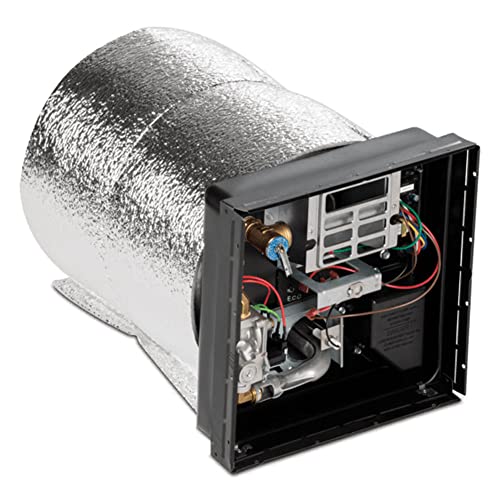


Write Your Review
No reviews yet. Be the first to share your experience!