


Cold-weather camping often exposes the severe limits of standard sleeping bags and layered bedding once temperatures plummet. Packing into a shelter during late autumn or midwinter requires a consistent source of warmth that does not flood the interior fabric with damp condensation. Choosing a reliable diesel heater for tent allows campers to maintain stable internal temperatures while keeping the actual combustion cycle isolated outdoors. Modern forced-air units use an enclosed burn chamber and an internal heat exchanger to blow clean, heated air through ducting directly into your shelter.
Finding the right portable setup requires balancing electrical power draw, fuel tank capacity, and control versatility. Most all-in-one enclosures run efficiently on 12V direct current from deep-cycle batteries or power stations, and several models also support household AC connections through included transformers. Understanding how these appliances manage ventilation, exhaust routing, and fuel metering ensures you stay comfortable in freezing conditions. For a broader look at indoor heating safety and air exchange, check our ventilation and combustion safety basics before taking specialized heating gear into backcountry environments.

Pros
- Operates on multiple electrical sources including 12V vehicle batteries, 24V systems, and 110V wall outlets
- Bluetooth smartphone app enables remote temperature adjustments and timer scheduling from up to 98 feet away
- Economical 0.04 to 0.1 gal/h fuel burn rate supports all-night heating from the 1.3-gallon internal tank
- Upgraded safety protections include a carbon monoxide alarm, overheat cutoff at 518°F, and reverse polarity defense
Cons
- Requires careful routing and secure exterior venting of combustion exhaust fumes before use in any enclosed space
- Carrying the 23.37-pound dry unit becomes significantly heavier once the 1.3-gallon tank is filled with fuel
- Manufacturer-listed coverage of 108 to 161 square feet is best suited for compact spaces rather than large uninsulated workshops
The VEVOR 8KW All-in-One Diesel Heater is an enclosed, fuel-burning forced-air heater engineered for portable and semi-permanent use in camper vans, RVs, trucks, rooftop tents, and detached garages. Designed for cold-weather travelers, outdoor enthusiasts, and workshop hobbyists, this unit consolidates the fuel tank, pump, combustion assembly, and electronics into a single self-contained gray housing. It suits buyers seeking an alternative to high-draw electric space heaters or propane units, delivering dry heated air without putting severe demands on campsite electrical circuits.
In terms of heating performance, the manufacturer rates this diesel unit at 8KW of thermal output, with listed coverage spanning 108 to 161 square feet. According to product specifications, it can produce warm air reaching up to 210°F within five minutes and warm a vehicle interior in approximately ten minutes. Thermostat controls allow target temperature settings from 46.4°F to 96.8°F. Because it consumes diesel at a rate of 0.04 to 0.1 gallons per hour with over 90% listed efficiency, the integrated 1.3-gallon fuel tank supports all-night operation during winter excursions without requiring mid-sleep refills.
The all-in-one chassis measures 16.73 by 12.6 by 12.2 inches and weighs 23.37 pounds, enclosing an LCD display, electronic control board, and fuel system within a structured shell. User control is straightforward, allowing adjustments via the onboard screen, the included handheld remote, or a Bluetooth smartphone app operating at distances up to 98 feet. Safety measures include an internal carbon monoxide (CO) alarm, an exhaust pipe heat sleeve, a sealed fuel cap, overvoltage defense, reverse polarity protection, and an internal circuit board programmed for automatic overheat shutdown at temperatures of 518°F or higher.
Setting up this diesel heater requires mindful placement, secure electrical connections, and strict exhaust management. Because combustion produces exhaust gases, the metal exhaust pipe must always be directed safely outside living and working quarters, using the supplied heat sleeve to shield nearby surfaces. Power flexibility is a strong highlight, as the unit accepts 12V DC, 24V DC, or standard 110V AC wall power without needing external transformers. It is also rated to operate at elevations below 9,842 feet, making it suitable for mountain campsites and high-altitude travel.
Prospective buyers should evaluate a few practical limitations before purchasing. Safe combustion venting is non-negotiable, meaning the heater cannot simply be placed indoors without routing exhaust completely outdoors. Additionally, while the 23.37-pound dry weight is manageable, adding 1.3 gallons of diesel adds noticeable heft during transport. The manufacturer-listed coverage of 108 to 161 square feet makes it ideal for vehicle cabins, small trailers, and compact work bays, but larger or drafty garages may require additional air circulation.
For camper van builders, truck drivers, overlanders, and garage hobbyists seeking dependable heat away from the power grid, the VEVOR 8KW diesel heater represents a practical and cost-conscious choice. Its tri-power compatibility across 12V, 24V, and 110V power sources simplifies setup across different environments, while the inclusion of app management and dedicated safety shutoffs provides modern operating convenience when installed and vented according to manufacturer directions.
The VEVOR 8KW diesel heater features multi-voltage versatility, operating on 12V or 24V direct current from vehicle batteries as well as standard 110V alternating current household outlets. This flexibility allows users to run the unit from an auxiliary battery bank off-grid or plug directly into a wall receptacle inside a garage or shed.
Fuel efficiency is supported by a quiet, metered fuel pump that consumes between 0.04 and 0.1 gallons of diesel per hour with a listed combustion efficiency exceeding 90%. Paired with the onboard 1.3-gallon diesel reservoir, the heater supports extended all-night heating cycles without requiring constant monitoring or frequent refueling.
Operational control is managed through three distinct interfaces: an integrated LCD screen on the heater body, an included handheld remote control, and a Bluetooth smartphone application with a transmission range of up to 98 feet. The Bluetooth app enables users to preheat cold interiors, configure operating timers, and adjust target temperatures between 46.4°F and 96.8°F directly from a mobile device.
An altitude operating capability rated up to 9,842 feet ensures that the fuel-to-air combustion mixture remains functional across high-elevation travel destinations without high-altitude stalling.
Combustion safety requires proper planning, and this VEVOR model integrates a carbon monoxide alarm, a sealed fuel cap to minimize vapor leakage, and a specialized heat sleeve for the exterior exhaust pipe. The internal control board features built-in reverse polarity prevention, overvoltage management, and an automatic overheat cutoff that activates if temperatures reach or exceed 518°F.
Because diesel combustion generates exhaust gases, this heater must always have its exhaust piping safely vented directly outside the vehicle, tent, or workspace. Users should adhere to manufacturer clearance guidelines, keep intake and exhaust pathways unobstructed, and maintain adequate fresh-air ventilation during operation.

Pros
- Included 110V transformer allows direct connection to standard household electrical sockets without purchasing an aftermarket converter
- Wide thermal output ranging from 4,700 to 17,000 BTU handles mild damp chills as well as extreme sub-zero weather down to -40°F
- Internal-threaded fuel cap prevents diesel spills and reduces fuel vapor odors during vehicle movement
- Comes with a pre-paired remote control operating up to 100 feet away for easy adjustments from across a room or vehicle
Cons
- Combustion operation requires strict adherence to manufacturer instructions regarding outside exhaust ducting and fresh air intake
- At 26 pounds empty, the unit becomes noticeably heavier to move once the 5-liter internal fuel reservoir is filled
- Requires ongoing diesel fuel management and basic combustion system upkeep compared to standard plug-in electric heaters
The LF Bros 5KW Diesel Air Heater is a self-contained, all-in-one forced-air heating unit built for owners of RVs, camper vans, workshops, trailers, and detached garages who need dependable warmth in severe winter climates. Unlike standard electric portable heaters that depend entirely on heavy household electrical current, this diesel-fueled system produces substantial dry heat while drawing minimal electrical power to operate its internal pump, fan, and control circuitry. The system is especially appealing for users who transition between mobile off-grid environments and stationary buildings because it includes a factory 110V transformer alongside standard 12V and 24V direct-current compatibility.
Heating performance centers around a 5-kilowatt burner capable of producing between 4,700 and 17,000 BTU of dry, forced-air heat. The system adjusts fuel delivery between 0.18 and 0.53 liters per hour depending on heating demands, allowing users to balance diesel consumption against outdoor temperature swings. Engineered to function in severe conditions ranging from -40°F up to 104°F, this heater delivers continuous forced warm air that effectively prevents cabin freeze-up and cuts through interior dampness. Actual heating comfort will vary based on insulation levels, ceiling height, and enclosure drafts, but the adjustable BTU output gives users flexible control over varying space sizes.
Build quality is highlighted by a compact, two-tone black and white chassis measuring 15 by 9.6 by 11.6 inches that encloses the burner, combustion blower, and fuel reservoir into a single structure. A notable design element is the 5-liter fuel tank cap, which features an internal automotive-style thread. This threaded design seals tightly to prevent fuel sloshing or leaking while traveling over rough terrain, addressing a frequent issue found on budget all-in-one heaters. Weighing approximately 26 pounds before fuel is added, the housing is sturdy enough for shop floors or camper compartments while keeping all vital mechanical components protected inside.
Operation and system setup are straightforward thanks to the included hardware, an LCD control switch, and a pre-paired remote control with an operating range of up to 100 feet. The LCD panel provides real-time operational status, while the remote allows convenient temperature and mode adjustments from across a camper bed or workshop bench. The package includes an instruction booklet and a QR code linking to an installation tutorial. Because this is a combustion appliance, safe installation strictly requires routing the exhaust pipe completely outside the living or working space, ensuring unrestricted combustion air intake, and adhering to all manufacturer clearance instructions.
A realistic evaluation reveals that while the LF Bros heater is remarkably versatile, it requires more setup diligence than a standard electric space heater. The unit requires proper ventilation, dedicated fuel handling, and careful exhaust pipe placement away from combustible surfaces or entry points. Additionally, while the 26-pound dry weight is manageable, filling the 5-liter fuel tank adds noticeable weight, making frequent manual relocation between sites less practical once the tank is topped off. The unit also requires a reliable 12V, 24V, or 110V power source to maintain the glow plug, fan, and fuel metering pump.
For homeowners, vehicle builders, and outdoor hobbyists seeking potent supplemental heat without overloading household electric circuits, the LF Bros 5KW All-in-One Diesel Heater provides an exceptional balance of power and convenience. The inclusion of an out-of-the-box 110V adapter eliminates the need to wire custom power converters for garage or basement use, while its native 12V/24V capability preserves off-grid vehicle readiness. When installed in accordance with proper exhaust and ventilation guidelines, it serves as a highly capable cold-weather heating companion.
The LF Bros 5KW Diesel Heater stands out for its versatile triple-voltage electrical configuration. In addition to standard 12V and 24V direct-current connections suited for camper vans, overland trucks, and marine battery systems, this unit includes a dedicated 110V AC transformer. This allows users to plug the heater directly into standard 110-volt household or workshop wall outlets without purchasing third-party power adapters or doing complex custom electrical wiring.
Fuel efficiency is driven by a precision metering system that consumes between 0.18 and 0.53 liters of diesel per hour across its 4,700 to 17,000 BTU operating span. Paired with the internal 5-liter fuel tank, the heater can sustain long periods of steady warmth before requiring a refill. The threaded, leak-resistant cap helps maintain clean operation during vehicle transport, preventing diesel odors and spills inside enclosed trunks or camper interiors.
Because the LF Bros 5KW heater operates via diesel combustion, safe venting is the single most critical aspect of the installation process. The heater generates carbon monoxide and hot exhaust gases during operation, requiring the exhaust pipe to be routed strictly to the outdoors away from doors, windows, and vehicle ventilation intakes. Users must never operate the combustion exhaust inside an unvented enclosed living or working area.
Installation guidance is supported by a comprehensive user manual and a scannable QR code directing buyers to an instructional video tutorial. Proper placement requires firm, level mounting and adherence to manufacturer clearance guidelines surrounding the hot exhaust tubing and heated-air outlet. Maintaining an unobstructed cold-air return path and routing fresh combustion intake air properly ensures clean, reliable burning even in sub-zero winter environments down to -40°F.
Pros
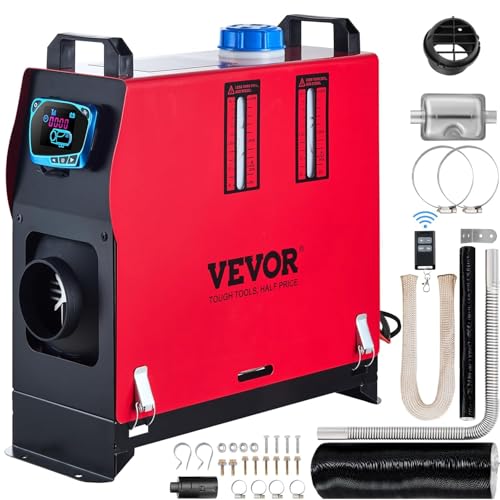
- All-in-one enclosed layout measures 16.22 x 7.09 x 16.14 inches for simplified placement in campers, cargo beds, or utility compartments.
- Consumes a modest 0.18 to 0.36 L/h of diesel, allowing extended overnight heating from the onboard 5-liter fuel reservoir.
- 98-foot remote control lets users trigger pre-heating from outside the vehicle to clear frost before entry.
- Engineered to maintain combustion stability at elevations up to 9,843 feet without complex manual adjustments.
Cons
- Requires complete exterior exhaust venting and proper clearance to discharge combustion gases safely outside the living space.
- Needs a dedicated DC 12V or 24V battery supply and cannot plug directly into a standard 120V household wall outlet without an external AC-to-DC converter.
- Not intended for unvented residential living rooms or indoor household bedroom heating.
The VEVOR 8kW Diesel Air Heater is an autonomous, forced-air parking heater tailored for mobile living spaces, overland builds, and commercial utility vehicles. Running on direct-current 12V or 24V electrical connections, this unit is engineered for owners of camper vans, RVs, travel trailers, sleeper cabs, and boats who need a dependable heat source independent of AC shore power or central propane lines. For travelers dealing with cold shoulder seasons or sub-freezing winter journeys, it provides focused thermal output specifically suited for enclosed spaces between 161 and 215 square feet.
Heating performance centers on an 8 kW internal combustion burner fitted with a rapid ceramic igniter for dependable cold-weather ignition. The heater draws from its built-in 5-liter (1.3-gallon) fuel tank via a precision low-noise fuel pump, maintaining a consumption rate between 0.18 and 0.36 liters per hour. According to manufacturer specifications, this combustion system delivers greater than or equal to 90 percent combustion efficiency, which translates to approximately one gallon of diesel consumed over a typical full night of runtime. This low fuel consumption rate allows users to maintain steady cabin temperatures through extended overnight stops without requiring frequent mid-trip refills.
Temperature regulation is managed through dual control options, giving owners flexibility whether resting inside or approaching the vehicle from a distance. The unit comes equipped with a 98-foot wireless remote control with pre-heating capabilities, letting users warm the cabin and defrost windows before entering. Inside, the blue LCD control switch allows users to monitor operational status and set target temperatures anywhere between 32 degrees and 104 degrees Fahrenheit. Additionally, the combustion design maintains stable operation at high elevations up to 9,843 feet, addressing a common failure point found in entry-level mobile heating equipment.
The physical construction utilizes an all-in-one red housing measuring 16.22 inches long, 7.09 inches wide, and 16.14 inches tall, weighing in at 18.3 pounds. To mitigate operational hazards common to diesel combustion units, VEVOR integrates an insulated exhaust pipe shield to help prevent scorching nearby vehicle bodywork or accidental contact burns. A leak-proof fuel cap helps contain liquid diesel on uneven roads and undulating terrain, while an onboard fuel gauge helps users monitor fluid levels to prevent dry burning and potential flameout issues.
Despite its convenience, prospective buyers should recognize the inherent installation and operational considerations of combustion equipment. Because the unit burns diesel fuel, the exhaust system must be routed completely outside the vehicle using heat-resistant metal ducting and proper exterior clearances to keep toxic combustion byproducts out of the living area. The heater also requires a sustained DC 12V or 24V power supply to run the electronics, ceramic igniter, and circulation fan, meaning it cannot simply be plugged into a standard 120V residential wall outlet. As a result, it is not suitable as a freestanding indoor home space heater.
For owners of conversion vans, overland rigs, commercial trucks, and boat cabins looking for an economical, fuel-efficient thermal system, this 8 kW parking heater delivers strong utility. Combining remote preheating functionality, elevation tolerance up to nearly 10,000 feet, and low hourly diesel consumption, it serves as a practical, off-grid heating upgrade for cold-weather road travel.
The VEVOR 8kW Diesel Air Heater features a versatile dual-control system consisting of an onboard blue LCD display screen and an extended-range wireless remote. The LCD interface allows operators to adjust the internal thermostat across a wide temperature range from 32 degrees to 104 degrees Fahrenheit, helping maintain consistent cabin comfort based on changing weather conditions.
The included remote control functions up to a distance of 98 feet, enabling convenient pre-heating functionality from outside the vehicle or campsite. This allows users to start the combustion sequence ahead of time, ensuring the cabin is pre-warmed and window frost is reduced prior to driving. The integrated electronic controller also automatically manages the ceramic igniter and fuel pump cadence to maintain combustion stability across varying altitude demands up to 9,843 feet.
This heater operates exclusively on standard diesel fuel stored within its integrated 5-liter (1.3-gallon) internal fuel reservoir. A precision-metered, low-noise fuel pump delivers a controlled fuel flow between 0.18 and 0.36 liters per hour, yielding an estimated consumption of approximately one gallon per night depending on the chosen thermostat setpoint.
Electrical power must be supplied by a DC 12V or DC 24V system, making it directly compatible with dual-voltage automotive batteries, auxiliary RV house battery banks, or mobile solar power stations. An external power source is necessary to operate the ceramic igniter during startup and to continuously power the LCD display, internal sensors, and forced-air blower fan during heating cycles.
Safe installation of the VEVOR Diesel Air Heater requires rigid adherence to combustion venting guidelines. The combustion intake and hot exhaust pipe must be securely ducted to the exterior of the vehicle or enclosure, utilizing the included heat-insulated exhaust shield to protect surrounding structural components from excessive heat and to reduce contact burn hazards.
The unit incorporates a leak-proof fuel cap to prevent spills during vehicular transit over rough terrain, along with an integrated fuel gauge that allows quick visual level checks to prevent dry-burning situations. Because this device combusts diesel fuel, it should never be operated in an unvented indoor room or residential space, and vehicle installations should always be paired with a functional carbon monoxide detector inside the living area.

Pros
- Multi-voltage compatibility allows seamless switching between camper battery banks (12V/24V) and garage AC wall power (110V/240V).
- Substantial 8KW maximum thermal output generates prompt, dry air heat for chilly outdoor cabins, camper builds, and service bays.
- Large 8-liter internal fuel reservoir eliminates the mess and complexity of mounting external fuel tanks.
- Included LCD controller, wireless remote, preheat function, and exhaust muffler provide complete operational control right out of the box.
- Threaded anti-leak fuel port prevents messy diesel spills during transport on bumpy roads.
Cons
- Requires careful outdoor exhaust pipe routing and proper combustion ventilation before operating in any enclosed structure.
- Fuel consumption scales noticeably under maximum load, ranging from 0.16 liters up to 0.62 liters per hour.
- Weighs significantly more when the 8-liter fuel tank is filled to capacity, reducing grab-and-go portability.
The RDXTIK 8L 8KW All-in-One Diesel Heater is engineered for vehicle dwellers, overlanding campers, and garage mechanics who need robust, dry forced-air heating without complicated component assembly. Unlike traditional split-system parking heaters that require mounting a separate fuel tank, fuel pump, and burner unit, this model houses all essential mechanical components inside a unified white metal chassis. For users seeking supplemental heat across varied environments, its self-contained configuration significantly simplifies transport and seasonal setup.
Heating capability centers on an 8000W diesel combustion core managed by a digital thermostat covering 46.4°F to 96.8°F (8°C to 36°C). The heater draws fuel from its built-in 8-liter tank via an internal low-noise pump, consuming between 0.16 and 0.62 liters of diesel per hour depending on heating demand. Under moderate settings, the manufacturer lists runtimes reaching up to 24 hours on a single fill, roughly equating to about one gallon across an overnight cycle. Users can regulate output directly via the mounted LCD screen or adjust heat levels from across the room using the supplied wireless remote control.
Electrical adaptability represents one of the standout aspects of this RDXTIK heater. While standard diesel air heaters are strictly restricted to 12V or 24V direct current, this model includes an integrated 110V to 240V AC power converter alongside standard DC leads. This allows owners to plug the unit straight into a typical home or garage outlet when working inside a workshop, or connect it directly to deep-cycle house batteries when parked off-grid in an RV, truck cab, or camper.
Installation versatility is aided by two swappable base configurations: a vibration-dampening rubber bottom and a rigid metal mounting base. Safety provisions include an internal thermal limit switch that triggers an automatic shutdown if internal operating temperatures meet or exceed 518°F (270°C). Furthermore, the fuel tank neck features an internal threaded design paired with a heavy-duty rubber O-ring to prevent diesel seepage while driving over rough trails.
Prospective buyers must recognize the combustion realities of any diesel-fired system. Although marketed for applications spanning vehicles, campers, and home spaces, this unit produces hot exhaust gases that must always be vented completely outdoors via the included exhaust pipe and muffler. It cannot be used as an unvented indoor room heater. Additionally, while the fuel pump features low-noise dampening, light pulsing sounds and fan movement remain noticeable during high-output operation.
For owners of conversion vans, overland rigs, detached workshops, and travel trailers, the RDXTIK 8L 8KW Diesel Heater offers exceptional value. Its built-in tank, bundled dual-voltage power supply, and straightforward digital controls make it a practical, high-output heating solution that avoids the complex installation hurdles of conventional split diesel systems.
Power supply flexibility is where the RDXTIK diesel heater distinguishes itself from conventional mobile heaters. The unit is pre-wired to accept both 12V and 24V direct-current systems, making it natively compatible with passenger vehicles, work trucks, boats, and off-grid solar battery banks. When connected to a standard 12V auxiliary system, it draws power to run the internal glow pin during ignition and sustain the combustion fan and low-pulse fuel pump throughout operation.
In addition to battery power, the package includes an AC adapter supporting 110V to 240V household current. This transformer allows users to run the heater directly from standard electrical outlets without purchasing aftermarket converters, making it just as convenient for backyard sheds and detached garages as it is for mobile camper setups. Paired with an internal 8-liter diesel tank that burns approximately 0.16 to 0.62 liters per hour, this unit delivers consistent heat across diverse power environments.
Because the RDXTIK heater generates heat through internal diesel combustion, safe venting practices are strictly mandatory. The combustion chamber takes in air from an intake pipe and discharges exhaust gases through a dedicated metal exhaust tube equipped with a muffler. These exhaust components become hot during use and must always exit directly to the open outdoor air, safely isolated from vehicle interiors, living spaces, and flammable materials.
The unit incorporates an overheat safety sensor that shuts down the burner if core temperatures reach 518°F (270°C). To ensure longevity and reliable operation, users should keep the hot-air ducting free of kinks, maintain proper clearance around the metal cabinet, and verify that the fuel fill cap gasket is properly seated before transit. Always operate a functional carbon monoxide alarm in any enclosed space where fuel-burning appliances are running nearby.
Pros
- Convenient wireless operation through Bluetooth smartphone app, 32-foot remote, and onboard LCD display
- Automatic altitude adjustment ensures reliable combustion in high mountain passes up to 18,045 feet
- All-in-one design eliminates the need to mount a separate fuel tank and pump assembly
- Rapid heat output using an efficient aluminum heat exchanger that warms the airstream quickly
Cons
- Requires a dedicated 12V DC battery or power converter to operate the internal electronics and glow plug
- Combustion exhaust pipe must be safely routed outdoors to eliminate deadly carbon monoxide risks
- High heat settings consume up to 0.62 liters per hour, which drains the 5-liter internal tank in roughly 8 hours
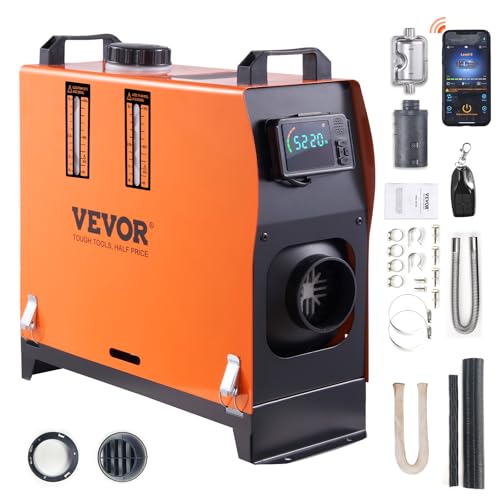
The VEVOR 8KW All-in-One Diesel Air Heater is a self-contained forced-air combustion unit engineered for mobile living, outdoor adventures, and off-grid heating needs. Housed in a compact, portable orange chassis measuring 15 by 5.9 by 16.1 inches, this unit integrates the fuel tank, burner, pump, and control unit into a single structure. It is designed primarily for camper vans, RVs, utility trailers, boats, and small outdoor structures where traditional AC electric heat is unavailable or impractical. For buyers who want substantial warmth without permanently cutting multiple mounting holes through their vehicle floor, this all-in-one layout provides a streamlined alternative.
Heating performance centers on an 8 KW burner paired with a sandblasting aluminum heat exchanger. The manufacturer lists the effective heating coverage between 215 and 269 square feet, making it well-matched for large vehicle cabins or compact recreational shelters. The internal heat exchanger achieves rapid heat transfer, allowing warm air to circulate through the discharge vent within approximately 10 minutes of starting. Temperature control is managed digitally, allowing users to select target comfort levels between 46.4 °F and 96.8 °F (8 °C to 36 °C). The unit also features an integrated timer and preheating functions to tailor operation to your daily schedule.
Control versatility is a standout attribute of this upgraded model. Users can adjust settings through three separate interfaces: an onboard LCD panel, an included wireless remote control operational up to 32 feet away, or a smartphone via Bluetooth connectivity up to 98 feet. The Bluetooth integration allows you to preheat your camper or workshop from outside before entering. Additionally, an automatic altitude compensation module adjusts the air-to-fuel ratio at elevations up to 18,045 feet (5,500 meters), preventing the carbon soot buildup and flame flameouts that commonly trouble non-compensating diesel heaters in the mountains.
Operating this heater requires both a standard 12-volt DC power source and clean diesel fuel. Fuel is stored inside the built-in 5-liter (1.3-gallon) tank, and a precision low-noise metering pump draws between 0.16 and 0.62 liters per hour depending on the heat demand. On lower settings, a full tank can provide continuous overnight heat for up to 8 hours on roughly one gallon of fuel. For safety, the system incorporates voice broadcasting status alerts and an integrated thermal safety sensor that initiates automatic shutdown if internal operating temperatures reach or exceed 518 °F (270 °C).
Because this is a fuel-burning appliance, proper installation and rigorous safety practices are required. The combustion exhaust pipe produces hot gases and carbon monoxide, meaning the exhaust must be routed entirely outside any occupied space with strict clearances from flammable materials. It cannot simply be set on a bedroom rug or operated inside an unvented living area. Furthermore, running the unit requires a 12V battery capable of handling the initial glow plug ignition draw, meaning indoor garage or home-office users will need an appropriate 12V DC power supply adapter.
For overland travelers, campers, van builders, and rural workshop owners needing serious off-grid heat, the VEVOR 8KW All-in-One provides an exceptional combination of heat output, modern controls, and high-altitude reliability. Provided you route the exhaust safely to the outside and supply steady 12-volt power, this compact heating unit offers reliable, dry forced-air comfort through freezing winter conditions.
The VEVOR 8KW Diesel Air Heater operates on standard diesel fuel drawn from an integrated 5-liter (1.3-gallon) fuel reservoir. Its precision internal metering pump regulates fuel delivery to maintain efficient combustion, consuming between 0.16 and 0.62 liters per hour based on your target temperature and ambient conditions.
Electrical power requires a 12-volt DC power supply to operate the digital motherboard, internal fan, fuel pump, and glow plug. The heater is not directly plug-and-play with 110V or 120V household AC outlets, so indoor workshop or garage users must pair it with a compatible AC-to-12V DC converter capable of handling the startup amperage required during the ignition cycle.
Operating the heater is flexible thanks to triple-mode control functionality consisting of Bluetooth smartphone access, an RF remote control, and a hardwired LCD panel. The Bluetooth companion app allows users to monitor operating status and initiate preheating from up to 98 feet away, while the portable remote offers standard adjustments from up to 32 feet.
The digital thermostat offers a temperature setting range between 46.4 °F and 96.8 °F (8 °C to 36 °C). In addition to constant temperature regulation, the unit features built-in timer settings and audible voice broadcasting that communicates operational status and diagnostic prompts directly to the user.
High-altitude performance is managed by an automatic altitude compensation sensor rated up to 18,045 feet (5,500 meters). The internal computer automatically recalibrates the fuel-air mixture to match lower oxygen levels at high elevations, preventing unburnt fuel accumulation and burner clogging during mountain travel.
Thermal safety is maintained through a built-in overheat protection sensor that automatically cuts power to the burner if internal temperatures reach or exceed 518 °F (270 °C). Because this unit burns diesel fuel, the metal exhaust pipe must always be vented securely to the outdoor atmosphere to prevent hazardous carbon monoxide accumulation in occupied areas.

Pros
- Automatic altitude adjustment ensures reliable combustion in high-elevation mountain environments up to 18,045 feet.
- Three versatile control interfaces provide convenient operation via Bluetooth app, wireless remote, or LCD screen.
- Large 10-liter fuel tank and low fuel consumption of 0.16-0.62 L/h support up to 16 hours of continuous warmth.
- Aluminum heat exchanger and overheat protection at 518 °F (270 °C) deliver durable, regulated heat production.
Cons
- Requires complete exterior combustion exhaust venting and strict clearance to avoid carbon monoxide hazards.
- Demands a dedicated 12V DC power source capable of handling initial glow-plug ignition draw.
- Installation requires technical mechanical assembly of fuel lines, air intakes, and exhaust piping.
The VEVOR 8KW Diesel Air Heater is a dedicated 12V combustion parking heater built for vehicle conversions, camper vans, travel trailers, boats, and garage workspaces. Designed for cold-weather travelers and off-grid utility users, this unit delivers high-output forced-air warmth powered by diesel fuel. It serves as an independent heating source that operates without relying on 120V household electric shore power, making it practical for winter road trips and remote base camps.
Rated at 8 KW with a 12V electrical requirement, the unit uses a sandblasting aluminum heat exchanger designed for rapid heat distribution. The manufacturer lists an applicable heating range of 215 to 269 square feet (20 to 25 square meters) and notes interior temperature rise within 10 minutes under proper conditions. Built-in automatic altitude compensation adjusts fuel delivery and airflow up to 18,045 feet (5,500 meters), helping prevent the rich-burning soot accumulation that often affects standard heaters in high mountain passes. The thermostat allows users to set target temperatures from 46 °F to 96.8 °F (8 °C to 36 °C).
The build quality centers around an aluminum core housed within a compact orange casing measuring 14.8 by 5.5 by 6.9 inches, with an overall weight of approximately 15.9 pounds. Fuel is metered through a precision low-noise pump drawing from the included 10-liter (2.6-gallon) external fuel tank. For operational monitoring and safety, the unit includes constant temperature regulation, a timer mode, voice broadcasting status updates, and automatic overheat protection that activates if internal temperatures reach 518 °F (270 °C) or higher.
System control is notably flexible, offering an onboard LCD display, a 32-foot wireless remote control, and Bluetooth app connectivity spanning up to 98 feet for preheating before entry. Installing this combustion heater requires strict attention to ventilation and clearance guidelines. The exhaust piping must vent completely outside living spaces and vehicle cabins to eliminate combustion byproducts, and the electrical leads must connect to a stable 12V DC power supply such as a deep-cycle auxiliary battery bank.
A realistic limitation is that this unit is not a simple plug-and-play electric room heater. It requires careful mechanical installation, including drilling mounting holes, securing fuel lines, and routing hot exhaust components safely away from flammable materials. In addition, adequate 12V DC battery capacity is essential to support the initial glow-plug draw during the startup sequence.
For overland travelers, van conversion builders, boat operators, and garage hobbyists equipped to install exterior exhaust routing properly, the VEVOR 8KW Diesel Air Heater represents a capable, fuel-efficient, and altitude-ready heating solution that delivers strong off-grid value.
The VEVOR diesel air heater is rated at 8 KW of heat output, engineered to warm spaces between 215 and 269 square feet. A sandblasting aluminum heat exchanger facilitates fast heat dissipation into the cabin or workspace.
Automatic altitude adjustment enables consistent operation at elevations up to 18,045 feet (5,500 meters). The system automatically modulates the combustion air-to-fuel ratio, preventing fuel-rich sooting commonly experienced with standard diesel heaters in high-elevation mountain travel.
Users can manage temperature and operation using three distinct control interfaces: an onboard LCD panel, a 32-foot wireless remote control, or smartphone Bluetooth app control with a working range up to 98 feet. The thermostat regulates temperatures between 46 °F and 96.8 °F (8 °C and 36 °C).
The system also features voice broadcasting alerts and timing functions, enabling users to schedule preheating sessions prior to entering a cold vehicle, boat cabin, or garage workshop.
This heater operates on diesel fuel supplied from the included 10-liter (2.6-gallon) tank, delivering up to 16 hours of continuous heating depending on user settings. Fuel consumption is rated between 0.16 and 0.62 liters per hour, utilizing a precision low-noise metering pump.
Electrical power requires a 12V DC connection capable of supplying ignition glow-plug draw during startup. For safety, exhaust piping must be routed completely outdoors, maintaining required clearances from heat-sensitive vehicle components.
Complete Setup and Operation Guide for Tent Heating
A portable forced-air diesel system provides a distinct heating advantage over traditional radiant or open-flame tent heaters by separating the combustion process from your living space. Standard portable propane appliances release water vapor and combustion byproducts directly into the tent atmosphere, often coating walls in thick condensation and presenting severe air-quality hazards. In contrast, an external diesel appliance burns fuel inside a sealed chamber, venting all toxic exhaust gases into the outdoor air while passing fresh air over a hot aluminum heat exchanger. This mechanism pumps bone-dry air into the shelter, dramatically reducing dampness while rapidly elevating ambient interior warmth.
Outdoor Placement and Critical Exhaust Routing
Operating any forced-air combustion appliance requires keeping the main unit situated entirely outside the living quarters. The combustion intake and exhaust pipes exit from the bottom of the casing, demanding a stable, level surface with plenty of ground clearance. Setting the heater on snow, soft dirt, or dry vegetation can lead to tipping or dangerous thermal contact. Using an elevated platform or mounting base with rubber vibration dampening prevents the unit from shifting during operation and isolates the mechanical pulse of the fuel pump from the ground.
Exhaust direction represents the single most important safety detail of your camp layout. Hot exhaust gases contain lethal carbon monoxide and must always discharge downwind from your tent, intake ducting, and neighboring campsites. Metal flexible exhaust piping gets hot enough during extended burns to melt synthetic fabric instantly, making protective heat-insulated sleeves an essential inclusion. Always inspect the connection clamps before starting the heater to guarantee zero exhaust leaks escape near the air supply ducting.
Fresh air intake for the heated circulation loop must also draw from a clean, unobstructed zone. Positioning the cabin air intake too close to the exhaust outlet will pull combustion fumes straight into the tent. Keep the intake port separated from the exhaust termination by several feet, pointing in the opposite direction whenever possible. Verifying this spatial separation protects everyone inside the tent from insidious gas accumulation while maintaining pure airflow throughout the night.
Electrical Requirements and 12V Battery Management
Every portable diesel air heater relies on a secondary electrical source to run its internal electronics, combustion fan, circulation blower, and fuel pump. During normal continuous operation, these appliances draw modest electrical currents, typically between 10 and 40 watts depending on fan speed. However, the startup phase demands significant instantaneous power to energize the internal ceramic glow plug. This ignition sequence draws anywhere from 8 to 12 amps at 12 volts for three to five minutes until the flame stabilizes inside the burner.
Standard lead-acid car batteries often struggle under repeated deep discharges and cold-weather voltage drops, which can trigger low-voltage shutoffs on the heater control board. A dedicated lithium iron phosphate (LiFePO4) battery or a portable power station with a regulated 12V output socket provides the stable current necessary to handle startup surges. Ensuring your power supply delivers uninterrupted voltage prevents sudden flame flameouts and frustrating startup failures in freezing conditions.
Several versatile units, such as the LF Bros 5KW model and the RDXTIK 8KW configuration, integrate internal transformers compatible with 110V or 240V household current. This dual-voltage capability allows you to preheat gear in a home garage, run directly from campsite shore power, or plug into an inverter generator without carrying auxiliary 12V adapters. When switching between AC grids and DC battery packs, always confirm cable gauges are thick enough to avoid resistive voltage drops over long wire runs.
Shutting down the heater requires letting the automated cool-down cycle run to completion without cutting main electrical power. Disconnecting battery leads while the combustion chamber is scorching hot traps residual thermal energy inside, which can warp internal blower housings and damage the control motherboard. The internal fan must run for several minutes after the fuel pump stops to lower the chamber temperature below critical thresholds. Always monitor the control panel until the fan halts completely before packing away power cords.
Heat Output Ratings and Cabin Sizing Dynamics
Choosing between 5KW and 8KW heating capacities depends primarily on the square footage and insulation quality of your shelter. A 5KW unit typically produces heat output ranging from 4,700 to 17,000 BTU/h, which is more than adequate for small ground tents, roof-top tents, and insulated teardrop trailers. Units in this class run efficiently at moderate duty cycles, reducing the likelihood of rapid on-and-off cycling that can lead to carbon buildup inside the burner chamber.
Larger uninsulated canvas tents, multi-room family shelters, and outfitter wall tents benefit significantly from the higher thermal ceiling provided by an 8KW diesel heater. Models in the 8KW bracket, like the VEVOR all-in-one systems, are engineered to heat spaces spanning 160 to 270 square feet rapidly. Sandblasting aluminum heat exchangers maximize heat transfer from the burner core to the circulation air, pushing warm air up to 210 degrees Fahrenheit at the duct exit within five to ten minutes of ignition.
Running a heater that is oversized for a compact, insulated tent can force the unit to idle at minimum power continuously. Operating constantly at bottom-tier output levels causes incomplete diesel combustion over extended periods, generating sooty deposits on the glow pin and flame sensor. Matching the burner rating to your shelter size and anticipated outdoor ambient temperatures prevents internal fouling and maintains crisp thermal response. For structural comparisons regarding seasonal heating, see our heating appliance planning guide for insights into managing intense heating sources in enclosed environments.
Fuel Consumption Rates and Tank Capacities
Diesel air heaters represent some of the most fuel-efficient portable heating systems available for backcountry use. A typical 5KW to 8KW heater consumes roughly 0.16 to 0.62 liters of fuel per hour, scaling linearly with the demanded temperature setting. At low-to-medium maintenance speeds, an efficient precision fuel pump uses approximately one gallon of diesel across an eight-hour night. This modest burn rate eliminates the need to haul heavy 20-pound propane cylinders on long wilderness excursions.
Integrated fuel tank capacities vary across standard all-in-one enclosures, directly influencing unattended runtimes. Compact portable units often feature a 5-liter (1.3-gallon) fuel reservoir, which comfortably covers a single cold night of continuous heating without topping off. Expanded designs, like the RDXTIK 8L and select VEVOR 10L systems, hold enough fuel to run between 16 and 24 hours continuously on conservative power settings, minimizing cold outdoor refueling trips in the dark.
Fuel cap engineering plays a subtle but vital role in safe transport and smooth operation. High-grade fuel caps feature automotive-style internal threads and rubber sealing gaskets to prevent diesel from leaking out when driving over rough, jarring terrain. Escaped diesel fuel leaves lingering, offensive odors on camping gear and poses environmental risks around sleeping areas. Ensuring the cap vent operates freely also prevents negative vacuum pressure from developing inside the tank, which could otherwise starve the fuel pump and cause sudden engine flameouts.
High-Altitude Performance and Automatic Compensation
High-altitude camping introduces significant atmospheric challenges for internal combustion equipment. As elevation climbs above 5,000 feet, thinner ambient air contains less oxygen per cubic foot, shifting the fuel-to-air ratio toward an overly rich mixture. In standard manual diesel heaters, an excessively rich mixture produces thick white or black smoke, rapid soot accumulation, and premature glow plug failure. Adjusting fuel delivery rates or fan speeds manually on basic LCD switches can be tedious and prone to user error.
Advanced models solve this operational hurdle by incorporating integrated barometric pressure sensors that automate altitude compensation. Advanced VEVOR 8KW units, for example, actively monitor ambient barometric shifts and automatically recalibrate the pulse frequency of the fuel pump up to 18,045 feet (5,500 meters). This automated trim maintains clean combustion, prevents carbon choking, and preserves steady thermal output without requiring manual tuning or specialized high-altitude motherboard reprogramming.
When operating units without automated altitude compensation, users must enter manual engineering menus to dial back fuel pump frequencies. Lowering the pump stroke volume leans out the burn mixture, matching the reduced oxygen volume present at mountain pass elevations. Regardless of the automation level, verifying that your exhaust tip remains free of heavy soot buildup provides clear physical confirmation that your heater maintains an optimal air-fuel ratio at your campsite elevation.
Ducting Setup and Condensation Control
Directing warm air from the outdoor heating unit into the tent requires durable, heat-resistant flexible ducting. Most standard kits supply flexible aluminum or foil-laminated ducting that clamps directly onto the hot air discharge collar. routing ducting through a designated stove jack, zippered electrical access port, or cracked door seam keeps the warm air flowing smoothly. Insulating the external portion of the hot air duct using a thermal wrap or neoprene sleeve prevents significant heat loss to the freezing outside air before the flow reaches the tent interior.
Condensation management is where a diesel air heater outshines almost every portable fuel-burning alternative. Because the system draws fresh air, warms it over a dry metal matrix, and exhausts combustion moisture outdoors, it delivers continuous low-humidity warmth. This constant dry airflow works as a powerful dehumidifier, evaporating breath moisture, wet boot dampness, and melting frost from the inner tent canopy. Campers wake up with completely dry sleeping bags and clear tent windows rather than moisture-soaked gear.
Proper air circulation inside the tent requires establishing a gentle cross-ventilation path. Even when running a dry forced-air system, cracking a small high-level roof vent allows displaced stale air to escape cleanly. Directing the warm air output across the tent floor encourages natural thermal convection, lifting heat upward and distributing it evenly across your sleeping pads. Securing ducting with sturdy worm-gear clamps prevents hot hoses from dislodging if someone accidentally kicks the line during the night.
Control Interfaces: LCD, Remotes, and Bluetooth Apps
Monitoring and managing tent temperatures has evolved significantly beyond simple mechanical rotary dials. Modern all-in-one heaters feature multifunctional LCD switches that mount directly on the casing or extend inside the vehicle via a long wiring harness. These screens display real-time operating metrics, including ambient temperature, setpoint goals, fuel pump frequency, error codes, and electrical supply voltage. Clear diagnostic codes eliminate guesswork if the system detects an overheating event, voltage drop, or ignition interruption.
Wireless remote controls provide immediate convenience by allowing campers to adjust temperatures without crawling out of a warm sleeping bag. Many factory remotes arrive pre-paired to the control receiver and operate reliably at distances between 32 and 100 feet. A quick tap on the handheld controller lets you preheat the tent before stepping inside, cycle between thermostatic and fixed-power modes, or dial back the fan speed once you settle down to rest.
Bluetooth app integration represents the latest upgrade in portable climate management, featured prominently on modern VEVOR platforms. By syncing your smartphone to the heater over a secure 98-foot wireless connection, you gain precision control over timing schedules, granular temperature increments (46.4 to 96.8 degrees Fahrenheit), and startup routines. The app screen also provides comprehensive visual feedback on system health, making field monitoring effortless and intuitive from your sleeping quarters.
Essential Carbon Monoxide Safety Protocols
While an external diesel parking heater is inherently safer than an unvented indoor catalytic burner, strict combustion safety rules must never be compromised. Every fossil fuel heating system produces carbon monoxide, an invisible, odorless, and potentially lethal gas. The primary defense against carbon monoxide in a tent setup is keeping the heater chassis, fuel combustion chamber, and metal exhaust pipe entirely outside the shelter walls. Never, under any circumstances, place the main heater enclosure inside your tent, vestibule, or enclosed awning.
Deploying a dedicated, battery-operated digital carbon monoxide detector inside your tent is mandatory for every cold-weather trip. Place the detector near head height in your sleeping area to ensure immediate alarm audibility while you rest. Even when using a unit equipped with an internal factory CO alarm or overheat shutoff sensors, an independent, certified detector provides life-saving redundancy against unexpected ducting punctures or wind shifts that might drive exhaust toward the shelter.
Routine physical inspections of your exhaust hardware should become a standard part of your camp setup routine. Check the exhaust pipe clamps for tightness, ensuring thermal expansion and road vibration have not loosened the metal seals. Inspect the flexible metal exhaust tubing for stress cracks, pinholes, or crushed sections that could restrict exhaust velocity. Maintaining unobstructed exhaust clearance and active internal air monitoring allows you to enjoy uninterrupted warmth with total peace of mind.
Pre-Trip Maintenance, Fuel Priming, and Storage
Reliable winter heating begins long before you arrive at a snowbound campsite. If a diesel heater has been stored unused for several weeks or months, the transparent fuel line connecting the tank to the burner will likely contain air bubbles. Attempting to start a dry system can trigger repetitive ignition failure codes as the fuel pump slowly purges air from the lines. Running the unit through a manual fuel-priming routine at home fills the filter and lines completely, ensuring instant firing on your first try in the field.
Fuel quality drastically impacts operational reliability when winter temperatures dip below freezing. Standard summer-grade diesel contains paraffin wax that crystallizes and gels around 32 degrees Fahrenheit, clogging micro-mesh fuel filters and seizing pulse pumps. In sub-freezing climates, fill your heater with winterized diesel (number 1 diesel) or mix in an approved anti-gel additive before heading into cold wilderness areas. Using clean, fresh fuel prevents fuel line blockages and preserves clean burning performance inside the combustion crucible.
Preparing your heater for seasonal storage preserves delicate internal gaskets and electrical contacts between camping seasons. Run the appliance on its maximum heat setting for twenty minutes before putting it away to bake off unburned soot deposits on the glow pin and heat exchanger fins. Once cooled, empty the fuel reservoir or seal the fuel cap tightly, cover the air intake and exhaust ports to keep out nesting insects, and pack the main enclosure in a protective padded box to shield the casing from moisture and physical impacts.
Setting up a portable diesel heating system transforms extreme cold-weather camping from an endurance test into a genuinely comfortable wilderness experience. By isolating the combustion cycle outside, supplying consistent 12V battery power, and maintaining vigilant exhaust separation, you secure clean, dry warmth throughout the harshest winter nights. Matching your specific tent dimensions to an appropriate 5KW or 8KW thermal profile ensures dependable, efficient performance across every cold-weather adventure.




Write Your Review
No reviews yet. Be the first to share your experience!