


Standard open hearths often pull warm air straight out of a living room, sending valuable thermal energy up the chimney while leaving your seating area cold. Adding a specialized heat exchanger like a custom firescreen spitfire 4 tube fireplace heater with blower captures that escaping energy and pushes it back into the room. Heating a drafty living space shouldn’t require burning through cords of wood without feeling real warmth on your toes. Installing dedicated circulation tubes directly in the firebox lets you harvest thermal energy from burning embers and logs before that heat vanishes. For homeowners who also need spark containment, pairing tube blowers alongside a fireplace barrier screen keeps the living area secure while warmth circulates.
Hearth dimensions, tube capacity, and blower speeds make all the difference in achieving steady supplemental zone heat. Units like the Woodeze Spitfire Fireplace Heater rely on heavy-gauge aluminized steel tubes to handle intense firebox temperatures while pushing heated air forward. A reliable two-speed blower provides flexible airflow control, letting you shift between rapid room heating and quiet background circulation throughout the chilly evening. Analyzing the manufacturer specifications helps confirm whether a compact setup fits your firebox depth and delivers adequate air volume for your den or cabin.
Pros
- Heavy-duty aluminized steel tubing resists prolonged high-heat firebox exposure
- Two-speed blower gives easy manual adjustment over warm air distribution
- Listed 45,000 BTU capacity helps salvage heat normally lost up the flue
- Substantial 41-pound weight stays firmly situated on the fireplace floor
Cons
- Requires nearby electrical access on or near the hearth to run the blower fan
- Dimensions of 28 x 11 x 17 inches require careful verification against interior firebox clearances
- Blower decibel levels and CFM airflow ratings are not specified in the product data
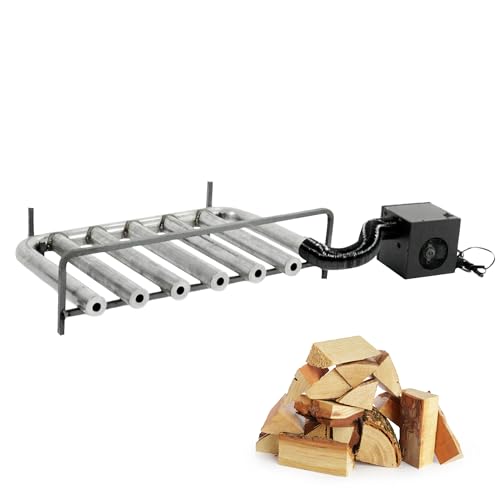
The Woodeze Spitfire Fireplace Heater is an active hearth heat exchanger built for homeowners who want to transform an inefficient open fireplace into a productive supplemental heat source. Most standard open fireplaces lose the vast majority of their thermal output through the chimney flue. This 6-tube steel unit rests inside the hearth, capturing heat directly from the fire and redistributing it into the room via an integrated blower fan.
Equipped with a listed heating output of up to 45,000 BTUs, this heater relies on six heavy-gauge aluminized steel tubes to transfer heat efficiently. As wood burns, the surrounding tubes absorb energy, allowing the built-in blower to draw cooler room air in through the lower intake and exhaust hot air back into the living area. The inclusion of a 2-speed blower switch lets users tailor airflow between a quiet, gentle breeze and higher-volume air circulation for quicker warming.
Build quality centers around high-temperature resilience, utilizing aluminized steel to resist thermal stress and corrosion over repeated heating cycles. Weighing in at 41 pounds, the unit has enough heft to remain securely seated on the fireplace floor without shifting during loading or routine wood tending. Its metallic industrial finish blends naturally with firebrick and cast-iron fireplace accessories.
With exterior dimensions of 28 inches in length, 11 inches in width, and 17 inches in height, this heater is marketed for smaller hearth footprints, dens, and cabins. However, prospective buyers need to verify that their firebox provides adequate depth, height, and width to accommodate both the tube rack and surrounding firewood safely. Operating the 2-speed blower also requires proximity to a standard electrical outlet, meaning power routing across the hearth must be planned in advance.
Potential buyers should note that specific electrical draw, power cord length, and fan airflow ratings (CFM) are omitted from the manufacturer specifications. Furthermore, this device functions as a supplemental heat circulator rather than a whole-home heating appliance, and total heat production depends on the size and intensity of the fire built on or around the tubes.
Overall, the Woodeze Spitfire is a well-built, practical upgrade for fireplace owners who love the ambiance of an open wood fire but want to recover usable warmth. For cabins, family rooms, and zone-heating applications with compatible firebox dimensions, it offers a functional alternative to high-cost structural fireplace inserts.
The Woodeze Spitfire Fireplace Heater measures 28 inches long, 11 inches wide, and 17 inches high, with a total weight of 41 pounds. These measurements encompass the full tubing assembly and blower configuration.
Before purchasing, homeowners must measure the internal floor width, rear taper, minimum height, and usable depth of their existing fireplace cavity. Adequate clearance must remain around the tubes to allow proper wood placement and prevent contact with fireplace doors or screens.
This hearth heater incorporates a two-speed blower designed to force air through the six aluminized steel heat-exchange tubes. The dual-speed control gives users the flexibility to dial in gentle, continuous circulation or switch to high speed when rapid room warming is needed.
Because the unit relies on an electric motor to circulate warmed air, buyers should ensure an accessible power source is available near the hearth. Always route electrical cords safely away from direct flame, hot coals, and radiant heat sources.
Frequently Asked Questions
How does a hearth tube heater with a blower circulate warmth into a room?
Hearth tube heaters capture room air at the hearth floor, channel it through steel tubes exposed to firebox heat, and blow warm air back into your living space. The heavy-gauge aluminized steel acts as a heat exchanger between active flames and circulating air. Running a built-in blower accelerates this convective loop so thermal energy enters the living area instead of drifting up the flue. This design turns an inefficient masonry fireplace into a functional supplemental heat source.
What should buyers verify before installing a Custom Firescreen Spitfire 4 Tube Fireplace Heater With Blower?
Buyers must verify firebox depth, width, rear taper, and electrical outlet access before installation. Tube assemblies sit directly on the fireplace floor, requiring adequate clearance beneath your firescreen or doors for blower cords and airflow outlets. If your hearth opening requires trim adjustments or a fireplace insert surround during upgrades, confirming inner firebox dimensions prevents clearance interference. Checking these measurements ensures the blower assembly sits flush without obstructing existing doors or spark guards.
What heating output can you expect from the Woodeze Spitfire Fireplace Heater?
Manufacturer specifications list a heating capacity of up to 45,000 BTUs for the Woodeze Spitfire Fireplace Heater. This output suits compact living areas, cabins, and drafty dens needing steady supplemental heat. Heat production naturally depends on your firewood volume, wood dryness, and fire intensity within the firebox. The integrated two-speed blower helps distribute that warmth quickly across the room rather than letting it linger around the hearth.
Can a fireplace tube heater work alongside custom firescreens or glass doors?
Yes, but only if the screen or door frame accommodates the blower housing and lower intake vents without pinching cords. Many tube heaters feature forward-facing air ports that project heat past the hearth boundary, yet door frames must leave room for the blower assembly. Checking clearance between the bottom rail of your firescreen and the hearth floor prevents heat buildup against glass panes. Reviewing exact manufacturer clearance diagrams ensures safe operation alongside decorative accessories in 2026.
Why is aluminized steel used in Spitfire hearth heaters?
Aluminized steel provides exceptional corrosion resistance and high-temperature durability under continuous coal and wood fires. Standard untreated steel can oxidize rapidly under the intense thermal stress of an active firebed. The aluminum-silicon coating on these heavy-gauge tubes withstands extreme firebox heat year after year without flaking or degrading. This metallurgical protection keeps the internal airflow channels clear for consistent heat circulation.



Write Your Review
No reviews yet. Be the first to share your experience!